📑 Table of Contents
- What an SMS Funnel Actually Is
- The Three Conversion Drivers in Every SMS Funnel
- Step 1: Choose One Funnel Goal and One Core Action
- Step 2: Build the Opt-In Offer That Feels Worth It
- Step 3: Set Expectations Immediately With a Strong Welcome
- Step 4: Segment Early So You Don’t Blast Everyone
- Step 5: Build the Activation Step That Creates Engagement
- Step 6: Create a Conversion Path With High-Intent Triggers
- Step 7: Write Conversion Messages That Remove Friction
- Step 8: Connect the Funnel to a Landing Experience That Matches the Text
- Step 9: Build the Post-Purchase Funnel That Creates Repeat Orders
- Step 10: Add a Win-Back Loop for Lapsed Subscribers
- Step 11: Add Guardrails So Funnels Don’t Collide
- Step 12: Measure the Funnel Like a System
- Two Full Funnel Examples You Can Model
- Ready-to-Use Funnel Templates
- Final Thoughts
SMS can drive fast sales, but only when it follows a plan. Many brands treat texting like a promo blast channel. They send discounts, hope for clicks, and then wonder why opt-outs rise. However, an SMS funnel works differently. It guides a subscriber from opt-in to first purchase, then to repeat purchase, using messages that match intent at each stage.
A funnel is not complicated. It is simply a sequence of actions that moves someone closer to a goal. In SMS, the goal might be a purchase, a booking, a referral, or a subscription. Therefore, the best SMS funnels focus on timing, segmentation, and low-friction next steps.
This guide breaks down how to build SMS funnels that convert, step by step. You will also get practical examples and templates you can copy.
What an SMS Funnel Actually Is
An SMS funnel is a connected set of messages and triggers that moves a person through stages.
- Stage 1: Opt-in and expectation setting
- Stage 2: Activation and first action
- Stage 3: Conversion and checkout completion
- Stage 4: Post-purchase success and repeat order
- Stage 5: Retention and win-back
You can build a funnel with automation, campaigns, or both. However, automation usually drives the best ROI because it triggers at the right moment.
Also, a funnel is not “more messages.” It is “better sequencing.” Therefore, your goal is to reduce noise while increasing relevance.
The Three Conversion Drivers in Every SMS Funnel
Every converting funnel includes three drivers. If you miss one, performance drops.
Relevance: The message matches the person’s intent or stage.
Friction removal: The next step feels easy.
Trust: The message feels safe and respectful.
So, every step you build should answer these questions.
- Why am I texting this person now?
- What is the simplest next step?
- How do I reduce uncertainty?
When you build with these questions, your funnel becomes clearer and more profitable.
Step 1: Choose One Funnel Goal and One Core Action
Funnels fail when they chase too many outcomes. Therefore, start with one goal.
For e-commerce, the goal is often the first purchase or repeat purchase. For services, it may be a booking confirmation. Moreover, for restaurants, it may be an order or a reservation.
Then define the core action that signals success. That action might be “checkout completed,” “appointment booked,” or “subscription started.”
Once you define one action, every message can point toward it.
Step 2: Build the Opt-In Offer That Feels Worth It
A funnel cannot convert without opt-ins. However, opt-ins depend on value.
So, choose a clear value promise. Early access. Restock alerts. Text-only perks. Appointment reminders. VIP drops. These work because they feel specific.
Avoid vague promises like “exclusive deals.” People have heard that before. Therefore, specificity wins.
Also, keep the opt-in experience fast. One form, minimal fields, clear disclosure, and a quick confirmation text.
Example opt-in promise: “Get restock alerts and early access by text. 2–4 msgs/month.”
This sets expectations and reduces regret.
Step 3: Set Expectations Immediately With a Strong Welcome
The welcome message is the start of the funnel. It should confirm subscription, deliver the promised perk, and explain what happens next.
Welcome template: “{Brand}: You’re in. Expect early access + restock alerts. Here’s your {Offer}: {Link}. Reply STOP to opt out.”
Then follow with one helpful message that reduces decision fatigue.
Second message template: “Not sure where to start? Here are our top picks: {Link}.”
This builds momentum without sounding aggressive.
Step 4: Segment Early So You Don’t Blast Everyone
Segmentation is the difference between funnels and spam.
At a minimum, segment new subscribers, buyers, and lapsed subscribers. Then add category affinity if you can.
You can also segment with one question. A quick two-way prompt can sort people fast.
Example: “Quick question: are you shopping for Men or Women? Reply M or W.”
Because replies create data, your funnel becomes smarter over time.
Step 5: Build the Activation Step That Creates Engagement
Many funnels lose people after opt-in. Subscribers join, then forget. Therefore, you need an activation step.
Activation means you get the subscriber to take a small action. Click a link. Reply to a question. Save preferences.
Simple activation message: “Want fewer texts and only the alerts you care about? Choose here: {Link}.”
Or use a reply-based activation: “Want deals or new drops? Reply DEALS or DROPS.”
Activation boosts conversion later because engaged subscribers trust you more.
Step 6: Create a Conversion Path With High-Intent Triggers
The highest-converting SMS funnels rely on triggers. Triggers match messages to behavior.
Here are the most valuable triggers for conversion funnels.
- Browse abandonment: subscriber viewed products but didn’t add to cart.
- Cart abandonment: subscriber added to cart but didn’t buy.
- Back-in-stock: subscriber asked for alerts or browsed an out-of-stock item.
- Price drop: subscriber viewed or saved an item that dropped in price.
Triggers work because they respond to intent. Therefore, they feel less spammy and convert better.
Step 7: Write Conversion Messages That Remove Friction
Conversion messages should do three things: clarify value, reduce effort, and guide a single action.
Cart recovery funnel example:
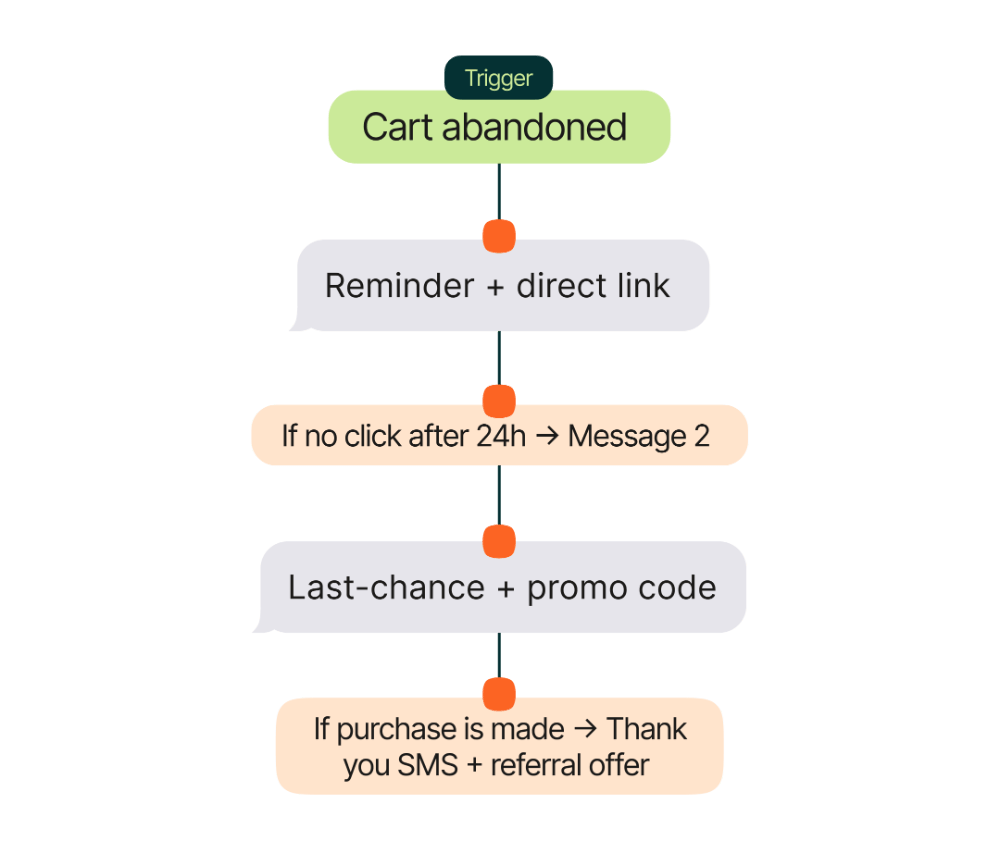
- Message 1 (60–90 minutes): “{Brand}: Your cart is saved. Finish checkout here: {Link}.”
- Message 2 (8–12 hours): “Need help with size or shipping? Reply HELP.”
- Message 3 (20–24 hours): “Last reminder today. Your items may sell out: {Link}.”
This sequence converts because it starts with convenience, then adds support, and then adds gentle urgency.
Browse funnel example:
- Message 1 (2–4 hours): “{Brand}: Still looking at {Category}? Here are the top picks: {Link}.”
- Message 2 (next day): “Want reviews and fit notes first? See them here: {Link}.”
These messages feel like assistance, not pressure.
Step 8: Connect the Funnel to a Landing Experience That Matches the Text
Many funnels fail after the click. The landing page does not match the promise. The code does not apply. Checkout feels slow.
Therefore, build message-match landing pages. If the text says “Top picks,” the page should show top picks. If the text says “Cart saved,” the link should open the cart.
Also, reduce steps. Use auto-applied discounts when possible. Use fast payment options. Keep the mobile speed high.
This is not just optimization. It is conversion math.
Step 9: Build the Post-Purchase Funnel That Creates Repeat Orders
A converting SMS funnel does not stop at the first purchase. The real profit often comes from repeat orders.
Post-purchase funnel example:
- Message 1 (immediately): “{Brand}: Thanks for your order. Tracking updates: {Link}.”
- Message 2 (delivery): “Delivered 🎉 Want quick tips to get the best results? {Link}.”
- Message 3 (3–7 days later): “How’s it going? Reply 1–5.”
- Message 4 (7–14 days later): “Most customers also love {AddOn}. See picks: {Link}.”
- Message 5 (replenishment window): “Running low? Reorder in 2 clicks: {Link}.”
This funnel drives repeat orders by building satisfaction first, then recommending next steps.
Step 10: Add a Win-Back Loop for Lapsed Subscribers
Not everyone buys again quickly. Therefore, add a win-back loop that triggers after a defined inactivity window.
Win-back funnel example:
- Message 1: “{Brand}: New favorites just landed in {Category}. Want a look? {Link}.”
- Message 2 (3–5 days later): “In case it helps, here’s free shipping through tonight: {Link}.”
- Message 3 (final): “Want fewer texts? Choose preferences here: {Link}.”
This loop reduces churn and saves subscribers who would otherwise opt out.
Step 11: Add Guardrails So Funnels Don’t Collide
Funnels can overlap. A subscriber might abandon a cart and also trigger a promo blast. That feels spammy. Therefore, you need guardrails.
- Add frequency caps: limit promotional sends per day or week.
- Add priorities: cart recovery overrides browse nudges.
- Add suppression: pause promos after purchase for 48–72 hours.
- Add exit rules: stop the flow after conversion.
Guardrails protect trust and deliverability, which in turn protect revenue.
Step 12: Measure the Funnel Like a System
If you only track clicks, you miss the truth. Therefore, track funnel metrics.
- Opt-in rate: how many visitors become subscribers.
- Activation rate: how many new subscribers click or reply.
- Conversion rate: how many subscribers buy.
- Revenue per subscriber: how valuable the list is over time.
- Opt-out rate: how the funnel impacts trust.
Also track drop-off points. If cart clicks are high but purchases are low, checkout friction is the bottleneck. If opt-outs spike after message two, timing or tone may be wrong.
Because funnels are systems, systems need diagnostics.
Two Full Funnel Examples You Can Model
Example 1: E-commerce first purchase funnel
- Opt-in offer: early access + restock alerts
- Welcome: perk + top picks
- Activation: preference question
- Browse: category picks
- Cart: saved cart + support + gentle urgency
- Post-purchase: delivery + tips + rating + add-on
- Replenishment: reorder + auto-ship option
- Win-back: new drops + soft incentive + preferences
Example 2: Service business booking funnel
- Opt-in: text reminders + last-minute openings
- Welcome: booking link + what to expect
- Activation: ask preferred days
- Booking abandon: “finish booking” + “need help?”
- Pre-appointment: confirm + directions + policy
- No-show prevention: day-of reminder + “running late?”
- Last-minute fill: waitlist + first-reply wins
- Post-visit: feedback + rebook link
- Win-back: seasonal check-in + priority slots
Both funnels convert because they match intent and reduce friction.
Ready-to-Use Funnel Templates
- Welcome: “{Brand}: You’re in. Expect {ValuePromise}. Here’s your {Offer}: {Link}.”
- Activation: “Want deals or new drops? Reply DEALS or DROPS.”
- Browse nudge: “Still shopping {Category}? Top picks here: {Link}.”
- Cart recovery: “Your cart is saved. Finish here: {Link}.”
- Support assist: “Need help choosing? Reply HELP, and we’ll jump in.”
- Post-purchase tip: “Quick tip for {ProductType}: {OneStep}. More: {Link}.”
- Repeat order nudge: “Running low? Reorder in 2 clicks: {Link}.”
- Win-back: “New favorites in {Category}. Want a look? {Link}.”
Final Thoughts
SMS funnels convert when they guide people through a sequence that feels relevant and easy to follow. Start with a clear opt-in promise. Set expectations fast. Segment early. Use behavior triggers to match timing with intent. Then build post-purchase and win-back loops to increase lifetime value.
Most importantly, treat SMS like a conversation channel. When you do that, your funnel feels helpful, not spammy. And when it feels useful, conversions follow.