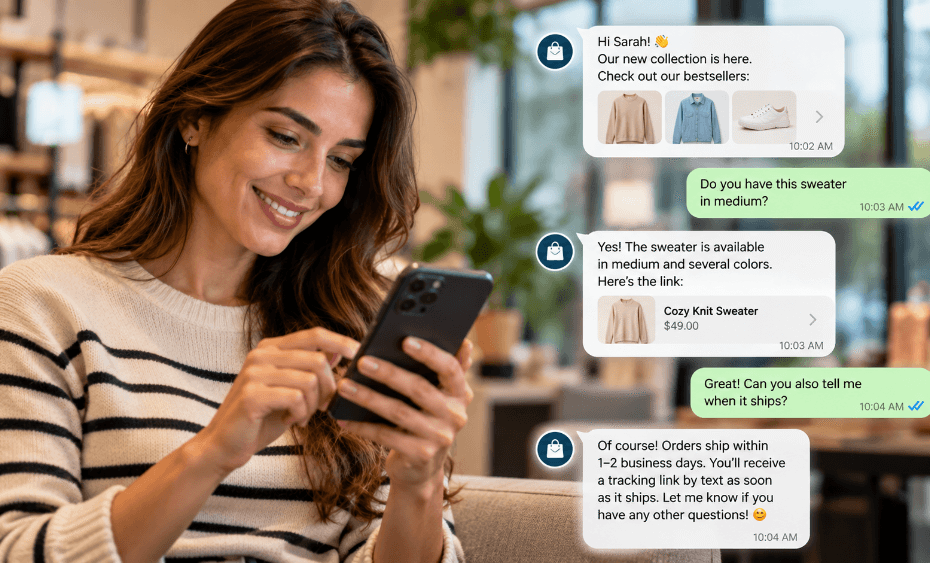
Conversational SMS marketing changes how businesses use text messaging. Instead of sending one-way promotions and hoping customers click, brands can create real back-and-forth conversations. Customers can ask questions, share preferences, confirm appointments, request help, choose products, and continue the relationship in the same message thread.
This matters because people do not experience brands as separate departments. They do not think, “This is a marketing message, and now I need a support channel.” They simply want help, answers, and relevant next steps. As a result, two-way texting can turn SMS from a broadcast tool into a relationship channel.
Additionally, customers increasingly expect fast, useful replies. If a brand sends a message but cannot respond when the customer replies, the experience feels incomplete. Conversational SMS solves that gap by combining marketing, service, automation, and human support.
Quick Answer: What Is Conversational SMS Marketing?
Conversational SMS marketing is a text messaging strategy where businesses and customers exchange two-way messages. A business may start with a campaign, reminder, or automated workflow, but the customer can reply and keep the conversation going.
For example, a retailer can send a product recommendation, and the customer can reply, “Do you have this in medium?” A clinic can send an appointment reminder, and the patient can reply, “Can I reschedule?” A real estate agent can send a listing alert, and the lead can reply, “Is there parking?”
In simple terms, conversational SMS turns text marketing into a dialogue rather than a one-way announcement.
Why One-Way SMS Is No Longer Enough
One-way SMS still has value. It works well for alerts, verification codes, delivery updates, flash sales, reminders, and simple announcements. However, it can feel limited when customers need context or help.
For example, a customer may receive a cart reminder but have a sizing question. If the number doesn’t accept replies, the customer must find another support channel. As a result, friction increases, and the sale may disappear.
Conversational SMS removes that friction. The customer can reply immediately, and the brand can respond with a helpful answer, an automated flow, or a human handoff. As a result, the original message becomes the start of a useful interaction.
How Two-Way Texting Builds Customer Relationships
Relationships grow when customers feel heard. Two-way SMS helps businesses listen, respond, and remember. Instead of treating every subscriber as a name on a list, brands can collect preferences, understand intent, and tailor future messages.
For example, a clothing brand can ask whether a customer prefers men’s, women’s, or kids’ styles. A gym can ask whether someone wants strength training, weight loss, or mobility support. A travel company can ask which destinations interest the customer.
Over time, these replies create better segmentation. Moreover, they make future messages feel more relevant. When customers receive content that matches their needs, they are more likely to stay subscribed and engage.
Common Use Cases For Conversational SMS
Conversational SMS works across sales, service, operations, and retention. It becomes especially useful when a customer’s reply can change the next step.
| Use Case | How Two-Way SMS Helps |
|---|---|
| Lead Qualification | Ask about budget, timeline, location, or service needs |
| Product Recommendations | Help customers choose size, color, model, or plan |
| Appointment Scheduling | Confirm, cancel, or reschedule through replies |
| Cart Recovery | Answer objections before checkout |
| Customer Support | Resolve simple issues inside the text thread |
| Feedback Collection | Ask for ratings, reviews, or improvement ideas |
| Loyalty Programs | Personalize rewards and VIP offers |
| Event Reminders | Confirm attendance or answer event questions |
These workflows work best when the message invites a clear reply. For example, “Reply 1 for pricing, 2 for availability, or 3 to speak with our team” gives the customer an easy next step.
Automation And Human Support Work Together
Conversational SMS does not mean every reply needs a human agent. Automation can answer common questions, collect details, route requests, and trigger workflows. However, human support still matters for complex, emotional, or high-value conversations.
A strong conversational SMS system uses both. Automation handles repetitive questions, while humans step in when customers need judgment or empathy. For example, an automated flow can collect an order number and identify the issue. Then, a support agent can review the case and reply with a personalized solution.
This hybrid model keeps response times fast without trapping customers in a bot. Additionally, it helps teams focus their energy where human attention creates the most value.
How Conversational SMS Improves Sales
Conversational SMS can boost sales because it captures intent the moment customers show interest. When someone replies to a promotion, product alert, or cart reminder, they are signaling active consideration.
For example, a customer who asks, “Does this come in black?” is closer to purchase than someone who simply opens a message. Therefore, the brand should treat that reply as a high-value opportunity.
Sales-focused SMS conversations can help businesses:
- Recommend the right product
- Answer objections quickly
- Share payment or checkout links
- Confirm availability
- Schedule a consultation
- Connect the lead with a salesperson
- Follow up after no response
However, the tone should stay helpful. Conversational SMS works best when the business guides the customer rather than pushes too aggressively.
How Conversational SMS Improves Support
Support teams can use two-way texting to reduce call volume, speed up resolutions, and make help more convenient. Many customers prefer texting because they can reply when they have time. They don’t have to wait on hold or explain the same issue multiple times.
Common support conversations include delivery questions, return instructions, appointment changes, warranty steps, billing questions, and service updates. Additionally, SMS can collect photos, order numbers, or short descriptions when MMS or links are supported.
The key is responsiveness. If a business invites replies, it should monitor them. Otherwise, conversational SMS can create frustration instead of trust.
Personalization Through Customer Replies
Customer replies are valuable because they create zero-party data. That means customers directly share preferences, needs, and intentions. Unlike assumptions based only on browsing or purchase history, reply-based data comes straight from the customer.
For example, a pet store can ask, “Do you shop for a dog, cat, or both?” A skincare brand can ask about skin type. A service business can ask which location the customer prefers. Then, future messages can match those answers.
This improves relevance. It can also reduce opt-outs because customers receive fewer random or generic messages.
Compliance And Trust In Two-Way SMS
Conversational SMS still needs strong compliance. Businesses should collect proper consent before sending marketing texts, clearly identify themselves, and provide a simple opt-out path. CTIA guidance emphasizes that non-consumer message senders should obtain consent before texting and provide a way for consumers to opt out.
Additionally, opt-out handling should work even when customers use plain language. CTIA best-practice materials note that standardized “STOP” wording should be used, but normal opt-out phrases such as “unsubscribe,” “cancel,” or “please opt me out” should also be recognized and acted on.
Trust matters because SMS feels personal. Therefore, brands should avoid over-messaging, misleading offers, unclear sender identity, and hard-to-find support. A good conversational SMS program respects the customer’s inbox.
Best Practices For Conversational SMS Marketing
The best conversational SMS strategies are clear, helpful, and easy to respond to. Every message should have a purpose and a natural next step.
Use these best practices:
- Ask simple questions
- Give customers clear reply options
- Respond quickly
- Route complex issues to humans
- Use customer replies for segmentation
- Keep message frequency reasonable
- Avoid long, email-style texts
- Make opt-out simple
- Track conversation outcomes
- Review unanswered replies regularly
Also, make sure teams know who owns each response type. Sales, support, operations, and marketing should not fight over the same inbox. Clear routing keeps conversations moving.
Metrics That Matter
Conversational SMS requires different metrics from one-way campaigns. Click-through rate still matters, but replies and outcomes matter more.
Track metrics such as:
- Reply rate
- Response time
- Conversation-to-purchase rate
- Lead qualification rate
- Resolved conversations
- Opt-out rate
- Customer satisfaction
- Revenue per conversation
- Human handoff rate
These numbers show whether conversations actually create value. For example, a campaign with fewer clicks but more high-intent replies may perform better than a campaign with many clicks and no meaningful engagement.

Final Thoughts
Conversational SMS marketing turns text messaging into a relationship channel. It helps businesses move beyond one-way promotions and create real conversations around sales, support, appointments, feedback, and loyalty.
Ultimately, two-way texting works because it meets customers where they already are and lets them respond naturally. When businesses combine consent, automation, human support, personalization, and fast replies, SMS becomes more than a marketing channel. It becomes a direct line to better customer relationships.