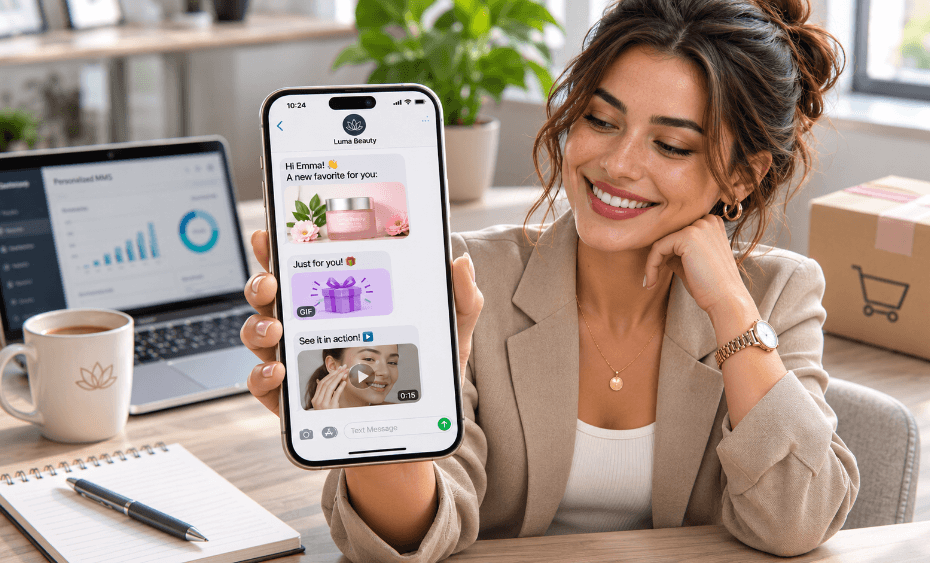
SMS works because it is fast, direct, and easy to read. However, some campaigns need more than plain text to capture attention.
That is where MMS marketing can add value.
MMS, or Multimedia Messaging Service, allows businesses to send images, GIFs, videos, and other media alongside text. When brands combine that visual content with customer data, segmentation, and behavioral triggers, the result can feel far more relevant than a generic promotional blast.
Current consumer data supports that opportunity. EZ Texting’s 2026 Consumer Texting Behavior Report found that 64% of consumers say they are more likely to click or purchase when a promotional text includes an image.
Therefore, personalized MMS can become a powerful tool when the visual itself helps the customer understand, evaluate, or act on an offer.
What Is Personalized MMS Marketing?
Personalized MMS marketing combines multimedia content with customer-specific information or behavioral data.
Instead of sending the same promotional image to an entire subscriber list, businesses can change the content according to what the customer has viewed, purchased, or shown interest in.
For example, an apparel retailer might send:
“Sarah, the jacket you viewed is back in stock.”
The MMS could include an image of that exact jacket rather than a generic sale graphic.
Similarly, a travel business could send a destination image based on a customer’s previous search, while a beauty brand could feature the specific product category someone purchased before.
As a result, the visual reinforces the message’s relevance.
Why Visual Content Can Improve Text Engagement
Text messages already receive fast attention. EZ Texting reports that 87% of consumers check new texts within 15 minutes.
However, attention doesn’t automatically lead to engagement.
A plain promotional message may communicate the offer effectively, but a useful visual can make the value easier to understand at a glance
For Example, an Image Can Show:
- What a product looks like
- How a new color or design appears
- What items are included in a bundle
- How a discount applies visually
- What an event or destination looks like
- What a finished result could resemble
Therefore, MMS works best when the image adds information rather than decoration.
A generic stock photo rarely creates the same impact as a product image that directly supports the customer’s decision.
Personalization Makes MMS More Powerful
Rich media alone does not guarantee a better campaign.
A visually impressive MMS can still feel irrelevant if the customer isn’t interested in the product.
Therefore, businesses should combine multimedia with segmentation.
Useful Personalization Signals Include:
- Recent product views
- Previous purchases
- Favorite categories
- Loyalty status
- Geographic location
- Cart contents
- Customer lifecycle stage
- Previous SMS engagement
- Replenishment timing
For example, a sports retailer could send running-shoe images only to customers who previously browsed or purchased running products.
Meanwhile, customers interested in cycling could receive a different MMS featuring helmets or accessories.
That approach creates a more relevant visual experience while reducing wasted sends.
Images Work Best for Product-Focused Campaigns
Static images remain one of the simplest and most reliable MMS formats.
They work especially well for products where appearance matters.
For Instance, Retailers Can Use Product Photography For:
- New product launches
- Seasonal collections
- Back-in-stock alerts
- Limited-edition releases
- Flash sales
- Product bundles
EZ Texting’s 2026 research specifically found that promotional texts with images increase the likelihood of clicks or purchases for 64% of consumers.
Therefore, a clean product image can help customers understand an offer before they even tap the link.
However, avoid overcrowding the image with excessive text.
The visual should attract attention, while the SMS copy explains the offer and provides the call to action.
GIFs Can Add Movement Without Full Video
GIFs create motion inside the message while remaining relatively simple.
They can help brands showcase several product angles, demonstrate a short feature, or add personality to a campaign.
For example, a fashion retailer might use a GIF to cycle through three colors of the same jacket.
Likewise, a restaurant could show several featured menu items in quick succession.
Attentive currently supports static images, GIFs, and MP4 videos for MMS and notes that 56% of consumers say they are more likely to engage with branded text messages that include visual elements such as GIFs, images, or emojis.
Therefore, GIFs can create more visual interest without requiring customers to press play.
However, movement should serve a purpose.
A distracting animation can make a campaign feel less professional, especially if the motion does not help explain the product or offer.
Video Can Explain More Complex Offers
Video gives brands more room to demonstrate a product or tell a short story.
For example, businesses might use short MMS video clips for:
- Product demonstrations
- Before-and-after results
- Event previews
- Short tutorials
- Service explanations
- New-feature introductions
A home improvement company could show a quick transformation. Meanwhile, a fitness brand could demonstrate how a piece of equipment works.
Therefore, video becomes useful when a static image cannot communicate enough.
However, file size and compatibility matter much more with video.
Twilio supports MMS media including common image formats and MP4 video. It currently allows a combined MMS size of up to 5 MB at the platform level, although individual carriers may enforce much lower practical limits.
As a result, businesses should compress video carefully and test delivery before launching large campaigns.
File Size Can Affect MMS Performance
Rich media introduces technical considerations that standard SMS does not have.
Different carriers and devices can resize, compress, or display media differently.
For example, Twilio notes that some carrier attachment limits are around 1 MB to 1.5 MB for long-code MMS, depending on the carrier. It recommends keeping some non-image attachments at 600 KB or below for broader compatibility.
Attentive recommends keeping images, GIFs, and video around 200 KB when possible, even though it supports larger files, because smaller files can improve speed and deliverability.
Therefore, marketers should optimize every asset before sending it.
A visually perfect 4 MB GIF provides little value if it loads slowly or fails on part of the audience.
MMS Should Support the Message, Not Replace It
A common mistake is relying too heavily on the visual.
Customers should still understand the basic offer from the accompanying text.
For example:
“Your favorite backpack is back in stock. Shop now before it sells out: [link]”
The image can show the backpack, but the copy still explains why the customer should act.
Therefore, the media and text should work together.
A Useful MMS Usually Contains:
- One clear visual
- One primary message
- One strong reason to act
- One obvious call to action
Avoid adding several competing products, multiple discounts, and too much copy inside one message.
Personalized MMS Works Well With Behavioral Triggers
MMS becomes even more effective when it responds to customer behavior.
For example, businesses can automatically send media-rich messages for:
- Browse abandonment
- Cart abandonment
- Back-in-stock alerts
- Price drops
- Replenishment
- Loyalty rewards
- Post-purchase recommendations
Imagine a customer repeatedly views a specific pair of shoes.
Instead of sending:
“Don’t forget to shop our footwear collection.”
The business could send an MMS featuring that exact shoe.
That message feels more relevant because the visual reflects the customer’s demonstrated interest.
Moreover, behavioral triggers reduce the need for broad promotional campaigns.
MMS Costs More Than SMS
MMS usually costs more to send than standard SMS.
Twilio currently lists U.S. outbound MMS starting around $0.022 per message before applicable carrier fees.
Therefore, marketers should not automatically convert every SMS campaign into MMS.
Instead, compare the additional cost with the potential improvement in engagement.
A simple appointment reminder probably does not need a GIF. However, a new product launch may benefit significantly from a strong visual.
So the right question is not whether MMS is better than SMS.
The question is whether the media adds enough value to justify the extra cost.
Test MMS Against SMS
Brands should avoid assuming that rich media always performs better.
Instead, run controlled tests.
For example:
- Version A: Plain SMS with offer and link.
- Version B: Same offer with a product image.
Then Compare:
- Click-through rate
- Conversion rate
- Revenue per recipient
- Cost per conversion
- Unsubscribe rate
- Revenue after messaging costs
Attentive also recommends A/B testing media formats because performance can vary by brand and audience.
Therefore, testing provides a more reliable answer than general industry benchmarks.
Keep Consent and Frequency in Mind
Personalized multimedia does not change the fundamentals of text marketing.
Businesses still need appropriate consent and clear opt-out handling.
Moreover, richer creative does not give brands permission to send more frequently.
EZ Texting reports that excessive message frequency remains the leading reason consumers unsubscribe from business texting, cited by 40% of respondents.
Therefore, brands should use MMS selectively.
A few strong visual campaigns can create more impact than constantly sending media-heavy promotions.
How to Build a Better Personalized MMS Strategy
Businesses can start with a relatively simple framework.
First, identify campaigns where visual information genuinely improves the offer.
Then:
- Segment customers according to relevant behavior.
- Choose one strong image, GIF, or short video.
- Keep the media file small and mobile-friendly.
- Write concise supporting copy.
- Use one clear call to action.
- Test MMS against plain SMS.
- Track revenue and conversions after messaging costs.
- Suppress customers after they complete the desired action.
- Monitor opt-outs and engagement.
- Reuse winning creative patterns across similar campaigns.
Most importantly, personalization should improve relevance.
Using a customer’s first name beside an unrelated image does not create meaningful personalization.

The Best MMS Campaigns Make the Visual Useful
Personalized MMS marketing can help brands stand out inside a crowded messaging environment.
Images can show products instantly. GIFs can demonstrate movement or variety. Videos can explain more complex ideas.
However, rich media works best when it supports a real customer need.
The strongest MMS campaigns combine useful visuals with behavioral data, smart segmentation, concise copy, and clear calls to action.
So businesses shouldn’t ask, “How can we add an image to this text?”
Instead, they should ask, “Would a visual make this message easier, clearer, or more persuasive?”
When the answer is yes, personalized MMS can turn a basic text campaign into a much more engaging customer experience.