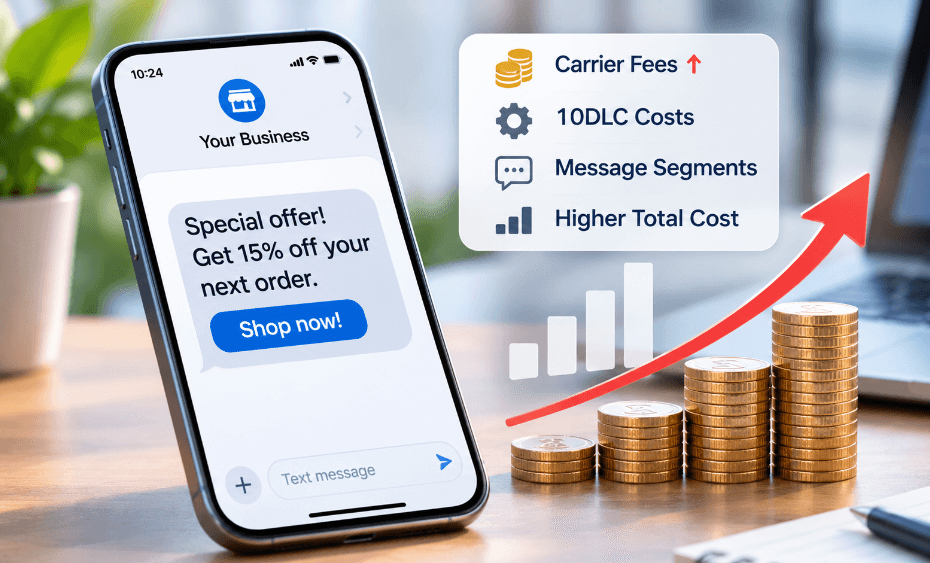
SMS marketing remains attractive because businesses can reach customers quickly through a channel almost every mobile phone supports. However, business texting costs go far beyond the base price an SMS provider shows.
Carriers increasingly add their own per-message surcharges, while businesses may also pay for phone numbers, A2P 10DLC registration, campaign vetting, monthly campaign records, MMS traffic, and optional messaging features.
Several U.S. carrier fees increased during 2026. Therefore, marketers preparing 2027 budgets should assume that SMS costs can change even when their messaging provider keeps its platform price unchanged.
The key is not to abandon SMS. Instead, businesses need to understand where messaging costs come from and make every send more efficient.
What Does an SMS Message Actually Cost?
Most SMS platforms charge a base messaging fee. However, that figure usually represents only one part of the final cost.
For example, Twilio currently lists U.S. outbound SMS at $0.0083 per segment across long codes, toll-free numbers, and short codes. Carrier passthrough fees apply on top of that base price.
Therefore, a Typical Business Messaging Bill Can Contain Several Components:
- Messaging provider fee
- Carrier surcharge
- Phone-number rental
- A2P 10DLC registration fees
- Monthly campaign fees
- MMS charges
- Optional compliance or analytics tools
- Failed-message processing fees
- Additional SMS segments
As a result, comparing providers based only on an advertised “price per text” can create misleading estimates.
Carrier Surcharges Are Becoming a Bigger Part of SMS Pricing
Carrier fees deserve particular attention because SMS providers often have limited control over them.
Mobile carriers charge messaging providers for traffic delivered to their subscribers. Then, providers generally pass those costs through to customers.
Current Twilio pricing shows outbound long-code SMS carrier fees of $0.0035 for AT&T, $0.0045 for T-Mobile, and $0.005 for Verizon. U.S. Cellular also carries a $0.005 outbound SMS fee.
Those amounts appear small individually. However, businesses sending hundreds of thousands or millions of messages can see meaningful differences in monthly expenses.
Moreover, fees can change during the year.
Bandwidth’s current surcharge table shows that Verizon’s registered outbound SMS surcharge increased from $0.0045 to $0.005 effective October 1, 2026. It also lists several other carrier changes during 2026.
Therefore, businesses should treat carrier pricing as a variable cost rather than a permanently fixed rate.
AT&T Increased Several Messaging Fees in 2026
AT&T provides another example of how carrier pricing can move.
Effective April 1, 2026, AT&T increased its registered 10DLC SMS surcharge from $0.0030 to $0.0035 for both inbound and outbound traffic. Additionally, its 10DLC MMS surcharge increased from $0.0075 to $0.0090.
The carrier also introduced or increased fees across short-code and toll-free traffic.
For example:
| Messaging Type | Previous AT&T Outbound Fee | 2026 Fee |
|---|---|---|
| 10DLC SMS | $0.0030 | $0.0035 |
| 10DLC MMS | $0.0075 | $0.0090 |
| Short Code SMS | $0.0030 | $0.0035 |
| Toll-Free SMS | $0.0030 | $0.0035 |
These changes don’t prove every major carrier will raise rates again in 2027. However, they show why businesses should build some pricing flexibility into future messaging budgets.
Message Segmentation Can Quietly Increase Costs
One of the easiest ways for businesses to underestimate SMS costs is by confusing a visible text message with a billable SMS segment.
A standard GSM-7 SMS can contain up to 160 characters in one segment. Once the message becomes multi-segment, each segment generally allows 153 characters because part of the message carries concatenation information.
Unicode changes the limits even more dramatically.
A UCS-2 message supports only 70 characters for a single segment and 67 characters per segment for longer concatenated messages.
As a result, one customer-facing text might create two or three billable segments.
For example, longer promotional copy, unusual symbols, or certain emojis can increase segment counts.
That Means Businesses Should Review:
- Message length
- Character encoding
- Emoji usage
- Personalization fields
- Long URLs
- Compliance language
Shorter copy can improve readability and reduce costs.
A2P 10DLC Adds Registration and Monthly Costs
Businesses using U.S. 10-digit long-code numbers also need to account for A2P 10DLC fees.
Registration helps carriers identify legitimate senders and understand the messaging use case. However, it introduces additional costs beyond message delivery.
Current Twilio documentation lists a one-time brand registration fee, a $15 campaign vetting fee, and recurring monthly campaign fees. Low-volume mixed-use campaigns may cost $1.50 per month, while standard campaigns can cost $10 per month depending on the use case.
Standard brand registration can also involve additional vetting fees.
Therefore, a company’s messaging budget should include infrastructure and compliance expenses, not just send volume.
For organizations managing several brands, campaigns, or customer accounts, these recurring fees can add up.
Unregistered Traffic Can Cost More
Registration does more than improve compliance and deliverability. It can also affect carrier pricing.
Bandwidth’s current surcharge table lists registered AT&T outbound 10DLC SMS at $0.0035, while unregistered traffic is $0.0100. T-Mobile registered outbound traffic is $0.0045, while unregistered traffic is listed at $0.012.
Therefore, failing to register correctly can increase messaging costs substantially while also creating filtering and deliverability risks.
Businesses should not view 10DLC registration as an optional cost-saving shortcut.
Instead, proper registration can help businesses access approved messaging routes and avoid the higher charges associated with unregistered traffic.
MMS Can Become Expensive Quickly
MMS costs more than SMS because it carries media such as images, GIFs, or other multimedia content.
Twilio currently lists U.S. outbound MMS at $0.022 before carrier fees. Meanwhile, major-carrier MMS surcharges can range from $0.007 to $0.010 depending on the network.
Therefore, a visual campaign can cost several times more per recipient than a simple SMS.
That does not mean businesses should avoid MMS entirely.
Instead, marketers should ask whether the media materially improves performance.
For instance, a product-launch image may increase engagement enough to justify the higher cost. However, adding a generic graphic to every promotion may increase expenses without creating additional revenue.
Optional Messaging Features Can Add Another Cost Layer
Messaging platforms increasingly offer compliance, scheduling, link tracking, AI, and analytics features as paid add-ons.
For example, Twilio currently lists its Engagement Suite and Compliance Toolkit at $0.015 per applicable outbound SMS, although the first 1,000 Engagement Suite messages are free each month.
Additionally, Twilio charges a $0.001 processing fee for messages that end in a failed status.
Therefore, businesses should evaluate optional services based on their actual value.
A click-tracking feature may justify its cost when attribution improves marketing decisions. However, paying for unnecessary add-ons across millions of messages can materially increase total spend.
Rising Costs Make Segmentation More Important
When each additional message costs money, sending every campaign to the entire subscriber list becomes harder to justify.
Therefore, segmentation becomes both a marketing strategy and a cost-control strategy.
Instead of sending a promotion to 100% of subscribers, businesses might target:
- Recent website visitors
- Active SMS clickers
- Customers interested in a category
- High-value buyers
- Subscribers who abandoned carts
- Customers likely to repurchase
Meanwhile, low-engagement subscribers can receive fewer promotional messages.
This approach reduces messaging spend while potentially improving revenue per recipient.
Automation Can Increase Efficiency
Automated messages often reach customers when intent is already high.
For example, abandoned-cart reminders, back-in-stock notifications, appointment reminders, and replenishment messages respond to specific customer behavior.
Therefore, businesses can concentrate spending on moments where a message has a clear purpose.
However, automation can also increase costs if several flows overlap.
A customer might receive an abandoned-cart text, a promotional campaign, a loyalty reminder, and a product alert within a short period.
So businesses should create global frequency caps and suppression rules.
More automation should not automatically mean more sends.
Businesses Should Start Tracking Revenue Per Message
As SMS costs rise, marketers need metrics that connect spend with results.
Total campaign revenue alone does not reveal efficiency.
Instead, Businesses Should Monitor:
- Revenue per recipient
- Revenue per SMS segment
- Cost per conversion
- Conversion rate
- Incremental revenue
- Gross profit after messaging costs
- Unsubscribe rate
- Customer lifetime value
For example, a campaign that generates strong sales but requires three SMS segments per recipient may be less profitable than a shorter campaign with slightly lower revenue.
Therefore, cost analysis should become part of campaign optimization.
RCS and WhatsApp Could Change the Cost Equation
Businesses entering 2027 may also compare SMS with alternative messaging channels.
RCS, for example, provides richer media, buttons, branded profiles, and conversational experiences. However, it also carries platform and carrier costs that vary by message type and network.
Twilio currently lists U.S. RCS rich outbound carrier fees ranging from about $0.0045 to $0.0062 across major carriers, while rich-media surcharges can rise above $0.01.
Meanwhile, WhatsApp uses a different pricing model based on platform and Meta template fees.
So the cheapest channel depends on the customer journey.
SMS may remain the best choice for a short delivery alert, while RCS could justify a higher cost for an interactive product experience.
How Businesses Can Prepare for SMS Costs in 2027
Companies cannot control carrier pricing, but they can control how efficiently they use messaging.
Start with these actions:
- Review current carrier surcharges regularly.
- Track average message segments per campaign.
- Keep 10DLC registrations accurate and active.
- Remove inactive or invalid subscribers.
- Segment audiences before promotional sends.
- Add frequency caps across campaigns and automations.
- Use MMS only when media adds measurable value.
- Monitor optional platform add-ons.
- Compare cost per conversion across channels.
- Negotiate volume pricing where available.
Twilio, for example, states that volume discounts may apply to its platform messaging fees, although carrier passthrough fees remain separate.
Therefore, high-volume businesses should examine both provider pricing and carrier costs separately.

SMS Costs Are Rising, but Efficiency Matters More
Carrier fee increases during 2026 show why businesses should prepare for SMS pricing to remain dynamic in 2027.
However, higher per-message costs do not automatically make SMS less valuable.
The more important question is whether each message creates enough business value to justify its cost.
Brands that continue sending broad, repetitive campaigns may feel rising carrier fees quickly. Meanwhile, businesses that segment audiences, shorten messages, optimize automation, and measure revenue per recipient can maintain strong economics even when individual messaging costs increase.
Ultimately, SMS budgeting in 2027 should focus less on finding the cheapest possible text and more on improving the value of every message sent.
Carrier fees may continue changing. An efficient messaging strategy is the part businesses can control.