
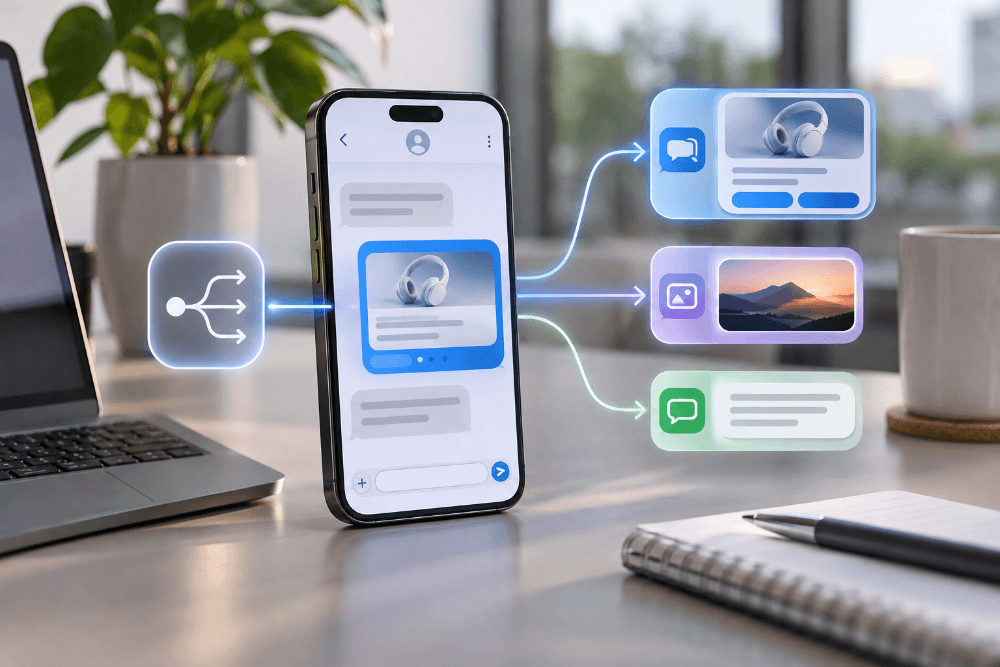
Business messaging is becoming more sophisticated. Instead of choosing one channel for every customer, companies can now route messages dynamically between RCS, MMS, and SMS according to device capabilities, message type, urgency, and delivery status.
That approach is often called smart messaging routing.
For example, a retailer might send an interactive RCS product message to customers with compatible devices. However, if the recipient cannot receive RCS, the platform can automatically fall back to MMS or SMS.
Smart routing lets businesses offer richer experiences without sacrificing reach.
The goal is not to send the fanciest message possible. Instead, businesses should choose the best available channel while ensuring the essential information still reaches the customer.
What Is Smart SMS Routing?
Smart routing uses rules, device information, carrier support, and delivery signals to determine which messaging channel should carry a message.
A typical routing strategy might follow this order:
- Attempt RCS when the customer and carrier support it.
- Use MMS if visual content remains important.
- Fall back to SMS when richer channels are unavailable.
- Monitor delivery status before attempting another channel.
Google explicitly recommends checking a user’s RCS capabilities before sending rich interactions. If the recipient cannot receive RCS, businesses can communicate through another service such as SMS or MMS.
Therefore, routing becomes a decision system rather than a fixed channel selection.
Why RCS Should Often Be the First Attempt
RCS provides the richest experience of the three channels.
Businesses can use:
- High-resolution images
- Product cards
- Carousels
- Suggested replies
- Action buttons
- Branded business profiles
- Read receipts
- Rich-media content
As a result, RCS can support customer journeys that plain SMS cannot reproduce.
For example, a retailer might send:
“Your favorite running shoes are back in stock.”
An RCS version could include the product image, price, “Shop Now,” “View Colors,” and “Find in Store” buttons.
However, not every device or carrier supports the same RCS capabilities.
Therefore, businesses should check the recipient’s capabilities before assuming that rich cards, carousels, or specific suggested actions will work. Google’s capability API can return the features available on a particular device.
Capability Checks Make Routing Smarter
One of the biggest advantages of RCS routing is knowing whether a recipient can receive the richer experience before sending it.
Google’s RCS for Business capability checks can identify whether a number is reachable and which RCS features the device supports. Successful checks generally rely on the device having connected to Google’s RCS service within the previous 31 days.
That means a routing engine can make more informed decisions.
For example:
| Device Capability | Best Routing Choice |
|---|---|
| Full RCS support | Rich RCS message |
| RCS without required rich feature | Simpler RCS message |
| No RCS support | MMS or SMS |
| Poor data availability | SMS fallback |
| Time-sensitive message | RCS with short fallback window |
Therefore, smart routing should not simply ask, “Does this customer have RCS?”
It should ask, “Can this customer receive the specific RCS experience we want to send?”
MMS Provides a Useful Middle Layer
MMS sits between RCS and SMS.
It does not provide the same interactivity as RCS, but it can deliver images, GIFs, and short videos to many smartphones.
So MMS is useful when visual content still matters, but RCS isn’t available.
For example, a product-launch flow could work like this:
- RCS: Product card, image, price, and interactive buttons.
- MMS: Product image plus promotional text and link.
- SMS: Short text description plus link.
The campaign goal remains the same, but the presentation adapts to the available channel.
However, businesses need to account for file-size limits.
Twilio currently supports up to 16 MB for RCS media and up to 5 MB for MMS. If an RCS message falls back to MMS, content larger than the MMS limit can fail.
Therefore, businesses should design fallback media from the beginning rather than assuming that the original RCS asset will always work over MMS.
SMS Remains the Reliability Layer
SMS offers the least rich experience, but it still provides the broadest compatibility.
Most mobile phones can receive SMS, and the channel does not depend on rich messaging support.
Therefore, SMS often becomes the final fallback.
For example:
“Your order #58291 is arriving tomorrow. Track it here: [link]”
The message lacks buttons and rich cards, but the essential information still reaches the customer.
That is why RCS and SMS shouldn’t be viewed as competing technologies.
Instead, RCS can provide the best experience when available, while SMS protects reach.
Twilio’s current RCS implementation can automatically try RCS first and fall back to SMS or MMS when the recipient’s device cannot receive RCS.
Delivery Status Should Control Fallback Timing
Smart routing becomes more complicated after the first send attempt.
Businesses should not immediately send an SMS just because an RCS message has not yet produced a delivery receipt.
Otherwise, the customer may receive both messages.
Google specifically recommends confirming that the original RCS message was not delivered before sending a fallback. It also recommends checking delivery receipts and attempting to revoke the RCS message before switching channels.
Therefore, fallback logic should consider message status rather than simply waiting a fixed number of seconds.
A Strong Workflow Might Look Like This:
- Send RCS.
- Wait for delivery confirmation.
- If delivered, stop.
- If the message expires or becomes undeliverable, trigger fallback.
- Send SMS or MMS.
- Record the final delivery channel.
This reduces duplicate messaging and unnecessary costs.
Message Expiration Should Match Urgency
Not every message should wait the same amount of time before fallback.
A product promotion may remain useful for several hours. However, a one-time password or appointment reminder can become useless very quickly.
Google allows RCS messages to use a time-to-live or expiration time and recommends shorter expiration periods for time-sensitive use cases. Its current guidance suggests at least 15 seconds for OTPs and longer windows for transactional or promotional content.
Likewise, Twilio recommends using a shorter validity period for urgent messages such as OTPs or appointment reminders instead of relying on its longer default timing.
Therefore, routing rules should depend on the business value of delayed delivery.
For example:
- OTP: Fast RCS attempt → rapid SMS fallback.
- Appointment reminder: Short RCS window → SMS fallback within minutes.
- Promotional campaign: Longer RCS window → fallback only if still relevant.
Fallback Content Should Be Designed Separately
One common routing mistake is treating the fallback as a technical afterthought.
A rich RCS message may contain several buttons, images, and product cards. Simply converting that experience into plain text can create confusing SMS copy.
Instead, businesses should prepare channel-specific versions.
For example:
- RCS: Product carousel with three products and “Shop Now” buttons.
- MMS: One hero product image with a category link.
- SMS: “New arrivals are here. Explore the collection: [link]”
Twilio’s fallback system supports content templates containing both rich RCS content and corresponding SMS or MMS versions.
Therefore, marketers should design the fallback experience alongside the primary message.
Sender Consistency Matters During Fallback
Channel switching can also affect the sender identity customers see.
A business may use a branded RCS sender but fall back to a 10DLC phone number for SMS.
If that number changes frequently, customers may find the experience confusing.
Therefore, businesses should use consistent fallback senders wherever possible.
Twilio introduced a FallbackFrom option in 2026 that allows businesses to specify which SMS or MMS number should handle fallback from an RCS message. That can help companies maintain routing consistency by department, store, or use case.
For example, a retailer could use one RCS brand profile while making sure all fallback texts come from its established customer-service number.
Smart Routing Can Control Messaging Costs
Richer messaging channels can cost more than basic SMS depending on the provider, carrier, and media type.
Therefore, smart routing should consider economics as well as technical capability.
For instance, a shipping confirmation may not need RCS.
SMS may already provide everything the customer needs.
Meanwhile, a high-value product launch could justify RCS because rich product cards may improve engagement.
A practical decision framework might look like this:
| Message Type | Recommended Priority |
|---|---|
| OTP | SMS or fast RCS → SMS fallback |
| Delivery alert | SMS or simple RCS |
| Product launch | RCS → MMS → SMS |
| Appointment reminder | RCS → SMS |
| Visual promotion | RCS → MMS → SMS |
| Emergency notice | SMS first |
| Customer-service conversation | RCS where available, SMS fallback |
So the richest channel shouldn’t automatically become the default.
Businesses should match channel value with message value.
Large Campaigns Need Different Routing Logic
Marketing campaigns introduce another challenge: queueing.
When businesses send hundreds of thousands of messages, platform queues can affect timing.
In July 2026, Twilio updated its RCS delivery and fallback behavior so queued campaign messages no longer fall back prematurely simply because they spent time waiting inside the Twilio platform.
That change matters because premature fallback could cause customers with perfectly valid RCS devices to receive SMS instead.
Therefore, Large Senders Should Review How Their Messaging Provider Distinguishes:
- Queue time
- RCS delivery attempts
- Device confirmation time
- Message expiration
- Fallback timing
Routing logic should reflect actual delivery conditions, not platform congestion.
Smart Routing Also Improves Analytics
A multi-channel strategy creates more useful data when businesses record which route ultimately delivered each message.
Teams can compare:
- RCS delivery rate
- RCS fallback rate
- MMS delivery rate
- SMS delivery rate
- Cost by channel
- Conversion by route
- Response rate
- Rich-media engagement
For example, a brand might discover that 70% of its audience receives RCS successfully, while the remaining 30% falls back to SMS.
Then, marketers can compare whether RCS recipients convert at a higher rate.
Therefore, routing data becomes part of campaign optimization rather than simply an engineering metric.
Avoid Duplicate Messages
Duplicate delivery is one of the most damaging routing failures.
Imagine receiving an RCS order confirmation and then an identical SMS five minutes later.
The experience feels broken.
Google recommends several safeguards, including checking delivery receipts, reusing message IDs during retries, using exponential backoff, and revoking the original RCS message before fallback.
Therefore, businesses should treat duplicate prevention as a core routing requirement.
More delivery attempts do not automatically mean better delivery.
How to Build a Smart Messaging Routing Strategy
Businesses can start with a relatively simple framework.
First, identify the message objective.
Then:
- Determine whether richer content adds value.
- Check RCS availability and device capabilities.
- Prepare RCS, MMS, and SMS versions where necessary.
- Set message expiration based on urgency.
- Wait for reliable delivery status before fallback.
- Use consistent fallback sender identities.
- Keep MMS assets below fallback size limits.
- Prevent duplicate sends.
- Log the final delivery channel.
- Compare cost and conversion by route.
Most importantly, test the full fallback journey on real devices.
A routing strategy that works perfectly in a diagram can still fail because of carrier support, media limits, delayed receipts, or incorrect fallback timing.
Better Delivery Comes From Using the Right Channel
Smart SMS routing does not mean forcing every message through RCS first.
It means selecting the best available channel for each customer and message.
RCS provides rich, interactive experiences. MMS keeps visual content available when RCS is not. SMS protects broad reach and reliability.
Therefore, the strongest messaging strategies combine all three rather than treating them as isolated channels.
Ultimately, customers do not care which protocol delivered the message.
They care that it arrived, looked right, and helped them do what they needed to do.
Smart routing makes that possible by prioritizing delivery reliability over channel loyalty.