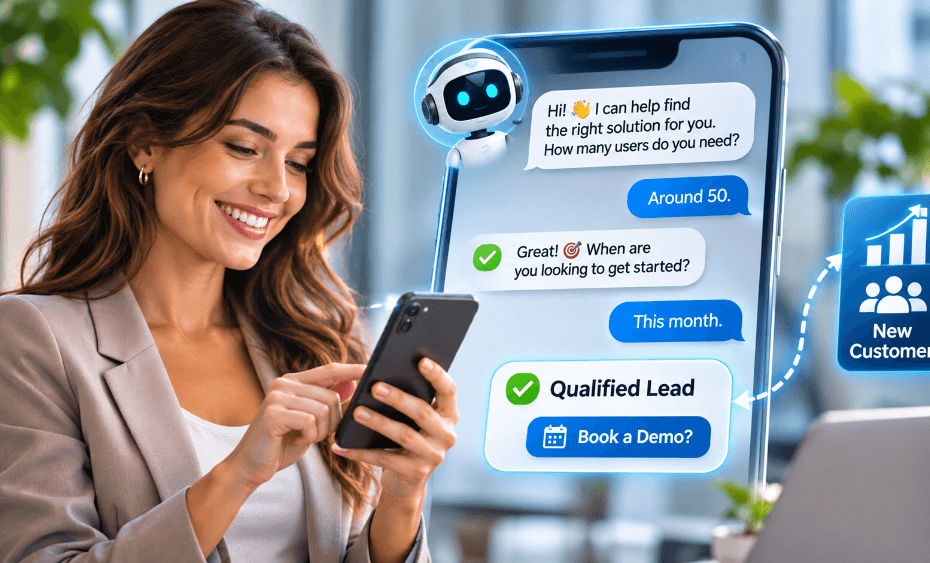
Many businesses generate more leads than their sales teams can contact quickly. Website forms, social ads, landing pages, referrals, and inbound calls can all generate inquiries, but slow follow-up often reduces conversion chances.
AI-powered SMS can help close that gap.
Instead of waiting for a salesperson to call every new lead, businesses can start a text conversation almost immediately. An AI agent can ask qualifying questions, identify purchase intent, collect useful details, and route high-value prospects to the right employee.
Moreover, SMS fits naturally into this process because customers already respond quickly to text. EZ Texting’s 2026 Consumer Texting Behavior Report found that 87% of consumers check texts within 15 minutes, while 82% respond within the same period. Nearly 70% also expect businesses to reply within one hour.
Therefore, AI lead qualification through SMS can speed up sales follow-up without forcing every prospect into the same manual process.
What Is AI Lead Qualification Through SMS?
AI lead qualification through SMS uses artificial intelligence to hold text-based conversations with prospects and determine how likely they are to become customers.
Traditional lead qualification often depends on forms, phone calls, or fixed chatbot menus. However, AI can interpret natural language and adapt the next question according to what the prospect says.
For example:
- Business: “Thanks for your interest. Are you looking for a solution for yourself or for a business?”
- Lead: “For my company. We have about 50 employees.”
- AI: “Got it. Are you looking to get started this month, or are you still comparing options?”
The system can use those answers to determine whether the person is ready for sales follow-up.
As a result, sales teams receive more context before they ever enter the conversation.
Why SMS Works Well for Lead Qualification
Lead qualification works best when prospects respond while their interest remains high.
SMS offers a major advantage because people tend to see and answer texts quickly.
EZ Texting reports that 89% of U.S. consumers have signed up to receive texts from at least one business. Moreover, 67% say they are more likely to purchase from a business whose texts they subscribe to.
Therefore, text messaging already plays an important role in customer decision-making.
Unlike email, SMS also reduces the chance that an inquiry sits unnoticed in a crowded inbox. Likewise, unlike a phone call, the customer does not need to stop everything and speak immediately.
That makes texting especially useful for early-stage qualification.
AI Can Respond to New Leads Immediately
Speed matters when a prospect has just submitted a form, requested pricing, or asked for more information.
Traditionally, a salesperson may not notice the lead until later.
AI can start the conversation almost instantly.
Twilio reports that 92% of consumers say AI typically responds within 30 seconds. However, customers also expect those fast responses to be useful, not robotic.
Therefore, a strong AI qualification flow should open with a helpful question rather than a long scripted introduction.
For example:
“Hi Alex, thanks for requesting a quote. I can help narrow down the right option. About how many users would need access?”
The question moves the conversation forward immediately.
AI Can Ask Better Qualification Questions
Good qualification does not mean asking every possible sales question.
Instead, the AI should collect only the information needed to determine fit and urgency.
Useful Qualification Factors May Include:
- Purchase intent
- Timeline
- Budget range
- Company size
- Product requirements
- Location
- Current provider
- Decision-making authority
- Main problem or goal
However, the flow should remain conversational.
HubSpot’s current AI lead-qualification guidance for business messaging recommends asking one question at a time and keeping messages short, helpful, and non-sales-heavy. It also suggests focusing on intent, urgency, company size, use case, and fit for sales follow-up.
Therefore, AI should feel like a useful assistant rather than a digital interrogation form.
Lead Scoring Can Happen During the Conversation
AI can do more than collect answers.
It can also evaluate them.
For example, imagine two leads:
| Lead | Qualification Signals | Likely Priority |
|---|---|---|
| Lead A | Needs solution this month, 100 employees, requests demo | High |
| Lead B | Researching for next year, no budget yet | Low |
| Lead C | Small team, strong urgency, exact product fit | Medium-High |
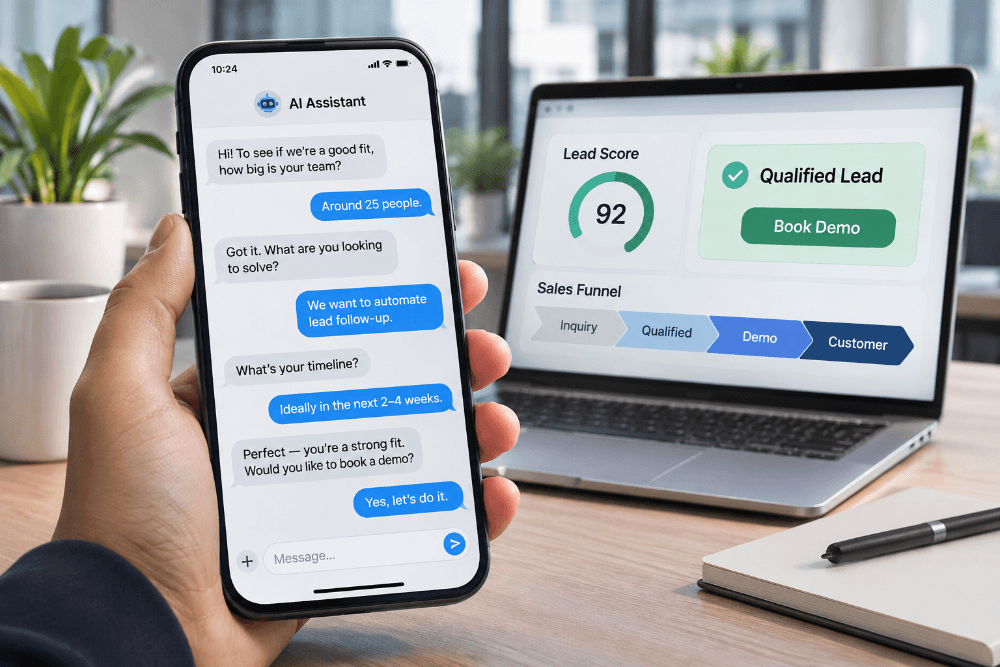
The system can assign a score based on predetermined criteria.
As a result, sales teams can prioritize leads that show stronger buying intent.
Moreover, AI can update the score as new information appears.
A prospect who initially says, “I’m just researching,” may later ask for pricing, implementation details, and contract terms. Those signals can automatically increase their priority.
AI Can Personalize the Next Question
Fixed qualification forms ask everyone the same questions in the same order.
AI conversations can adapt.
For instance, a lead asking about enterprise pricing should receive different questions from someone looking for a basic plan.
Likewise, a customer interested in a home service may need location and property details, while a software prospect may need questions about users, integrations, and deployment timing.
Therefore, AI can reduce unnecessary steps.
Instead of asking ten questions every time, it can ask only the questions that matter for that particular lead.
This can make the conversation feel faster and more relevant.
SMS Can Move Leads Toward the Next Action
Qualification should not become a dead end.
Once AI identifies a strong lead, it should make the next step simple.
For example, it could offer:
- Book a demo
- Schedule a call
- Request a quote
- Speak with sales
- View available products
- Start an application
- Visit a showroom
- Complete checkout
The key is matching the CTA to the lead’s readiness.
For example:
“It sounds like our Pro plan could fit what you need. Would you like me to show available demo times?”
That feels more natural than immediately pushing every lead toward a sales call.
AI Should Know When to Hand Off to Sales
The goal of AI qualification is not to keep salespeople away from prospects.
It is to bring humans into the conversation at the right time.
Businesses should create clear escalation triggers.
These May Include:
- High lead score
- Request for pricing
- Request for a demo
- Contract questions
- Complex product requirements
- Strong purchase urgency
- Customer asks for a salesperson
- AI confidence becomes low
However, handoff quality matters.
Twilio reports that 78% of consumers consider the ability to switch from AI to a human important, yet only 15% say they have experienced a truly seamless handoff.
Therefore, the salesperson should receive the conversation history, lead score, key answers, and reason for escalation.
The prospect should not have to repeat everything.
AI Can Also Help Sales Teams After Handoff
AI does not need to disappear once a salesperson takes over.
Instead, it can continue helping behind the scenes.
For example, AI can:
- Summarize the lead conversation
- Highlight buying signals
- Suggest follow-up questions
- Recommend relevant products
- Identify objections
- Draft a reply
- Update CRM fields
- Flag urgency
As a result, sales employees spend less time reviewing notes and more time talking to qualified prospects.
This creates a smoother transition between automation and human selling.
Conversational AI Needs Reliable Customer Context
AI qualification becomes much more useful when it understands where the lead came from.
For example, someone who clicked an ad for enterprise software should not receive the same opening questions as someone requesting a consumer product quote.
Useful Context May Include:
- Landing page visited
- Ad campaign source
- Product viewed
- Form submitted
- Geographic location
- Existing customer status
- Previous conversations
- CRM data
However, businesses need to use customer data carefully.
Twilio reports that 54% of consumers believe AI agents rarely or never have enough customer context. Meanwhile, 51% feel uncomfortable sharing personal or financial information with AI agents.
Therefore, businesses should use only the information needed to improve the conversation and clearly protect sensitive data.
Automation Should Not Feel Like a Barrier
AI lead qualification can fail when businesses try to automate too much.
For example, a highly qualified lead might ask:
“Can someone call me now?”
The AI should not force that person through five additional questions.
Likewise, if someone has already provided company size and budget on a form, asking those questions again creates unnecessary friction.
Therefore, AI should reduce customer effort rather than simply maximize completed qualification fields.
The best flow recognizes when it already has enough information.
Measure Quality, Not Just Conversation Volume
A successful lead qualification program should not be judged by how many conversations the AI starts.
Instead, businesses should measure what happens afterward.
Useful Metrics Include:
- Lead response rate
- Qualification completion rate
- Sales-qualified lead rate
- Time to first response
- Demo booking rate
- Human handoff rate
- Conversion rate
- Cost per qualified lead
- Revenue per qualified lead
- Opt-out rate
Businesses should also compare AI-qualified leads with leads handled through traditional workflows.
For example, if AI increases qualification volume but produces lower-quality opportunities, the system may need stricter scoring criteria.
Therefore, revenue and conversion matter more than raw conversation counts.
Consent Still Matters for SMS Lead Follow-Up
AI does not remove SMS compliance requirements.
Businesses should make sure they have appropriate permission before sending automated marketing or sales texts.
A lead who submits a phone number for one specific purpose does not automatically consent to unlimited promotional messaging.
Therefore, the opt-in language should clearly explain what messages the prospect may receive.
Moreover, the System Should Recognize Opt-Outs Such As:
- STOP
- UNSUBSCRIBE
- Remove me
- Don’t text me
- Please stop
Compliance controls should sit at the platform level so an AI agent cannot accidentally ignore a valid suppression request.
How to Build an AI SMS Qualification Flow
Businesses can begin with a simple structure.
First, define what makes a lead valuable.
Then:
- Trigger the SMS immediately after a relevant inquiry.
- Reference the lead’s original request.
- Ask one qualification question at a time.
- Keep messages short.
- Score answers using clear criteria.
- Adapt questions according to previous responses.
- Stop asking once enough information exists.
- Escalate strong or complex leads quickly.
- Send full conversation context to sales.
- Track conversion after handoff.
Most importantly, test the conversation from the customer’s perspective.
A qualification flow should feel helpful, not like a form broken into ten text messages.
The Best AI Qualification Feels Like Helpful Sales Assistance
AI-powered SMS can dramatically shorten the distance between an inquiry and a meaningful sales conversation.
It can respond within seconds, collect useful information, identify intent, score prospects, and route qualified leads to the right person.
However, automation alone does not turn inquiries into customers.
The experience still needs relevance, speed, human escalation, accurate data, and good sales follow-up.
Therefore, businesses should use AI to remove delays and repetitive qualification work rather than replace human selling completely.
The strongest approach combines both.
AI handles the predictable early questions. Salespeople step in when the conversation becomes valuable, complex, or ready to close.
When that handoff works smoothly, SMS becomes more than a marketing channel. It becomes a fast, conversational path from first inquiry to qualified opportunity—and eventually, to customer.