
Customer service texting is moving far beyond simple order alerts and appointment reminders. Businesses increasingly use SMS, RCS, WhatsApp, and other messaging channels to handle complete support conversations.
At the same time, artificial intelligence is changing how those conversations begin, how quickly customers receive answers, and when human agents step in.
However, the future is not simply “AI replaces customer service representatives.”
Current research points toward a hybrid model. AI handles repetitive tasks, gathers information, and resolves straightforward issues. Meanwhile, human agents manage exceptions, emotion, judgment, and complex problems.
Therefore, the strongest customer service strategy will combine AI speed with human judgment while preserving the conversation as customers move between them.
Customers Increasingly Expect Support Through Messaging
Business texting has matured quickly.
EZ Texting’s 2026 Consumer Texting Behavior Report found that 89% of surveyed U.S. consumers have already signed up to receive texts from at least one business. Moreover, 87% check new texts within 15 minutes, while 70% expect a business to respond within one hour when they send a message.
Those expectations change customer service.
A customer who texts a business rarely expects the same response time as traditional email. Instead, texting feels immediate.
Businesses that offer SMS support need systems that can respond quickly, even when human teams get busy.
That is one reason AI is becoming so important.
AI Will Handle More of the First Response
AI can reduce the time between a customer’s question and the first useful action.
For example, a customer might text:
“My package was supposed to arrive yesterday. Can you check it?”
An AI support agent connected to the order system could identify the customer, retrieve tracking information, and respond within seconds.
Similarly, AI Could Handle:
- Order-status questions
- Appointment scheduling
- Store hours
- Product availability
- Return instructions
- Basic billing questions
- Account information
- Simple troubleshooting
As a result, customers don’t need to enter a traditional support queue for routine requests.
Moreover, this creates value outside business hours. A customer may receive useful assistance at 10 PM even when human agents return the following morning.
AI Is Moving From Answering Questions to Taking Action
Early customer service chatbots mainly answered FAQs.
Modern AI agents can increasingly complete tasks.
Gartner’s 2026 customer-service research found that 58% of customers who use GenAI have already used it to complete an action on their behalf. In B2B environments, that number rises to 74%.
That shift matters for customer service texting.
Instead of Simply Telling a Customer How to Reschedule an Appointment, an AI Agent Could Potentially:
- Check available times.
- Offer suitable alternatives.
- Confirm the customer’s choice.
- Update the scheduling system.
- Send the new confirmation.
Likewise, an agent could change delivery preferences, start a return, retrieve an invoice, or book a service.
As a result, customer service texting becomes more transactional and useful.
Human Agents Will Remain Essential
AI can handle more customer interactions, but customers still want access to people.
Gartner found that 87% of surveyed customers consider it essential for companies using generative AI in customer service to provide a human-agent option. Interestingly, the same research found that 50% say GenAI makes service interactions easier.
So customers don’t necessarily reject AI.
They reject being trapped by it.
Human Agents Remain Especially Important When Conversations Involve:
- Complex billing disputes
- Large refunds
- Repeated service failures
- Unusual policy exceptions
- Sensitive customer circumstances
- High-value accounts
- Strong frustration
- Complex technical problems
In these situations, judgment and empathy matter more than speed alone.
AI Should Never Become a Barrier to Human Support
One of the biggest mistakes businesses can make is treating human escalation as a failure.
Instead, escalation should represent part of the intended customer journey.
For example, if a customer writes:
“I’ve already explained this three times. I need to speak with someone.”
The system should recognize the request quickly.
A good AI agent should not respond with another troubleshooting question.
Twilio’s research found that 78% of consumers consider the ability to switch from AI to a human important. However, only 15% report experiencing a genuinely seamless AI-to-human handoff.
That gap represents one of the biggest opportunities in customer service texting.
Seamless Handoffs Will Become a Competitive Advantage
Imagine a customer spends five minutes explaining a problem to an AI agent.
Then, the conversation transfers to an employee who says:
“Can you explain what happened?”
The customer must start again.
That experience eliminates much of the convenience AI was supposed to create.
Therefore, the future of customer support depends heavily on warm handoffs.
Twilio’s 2026 guidance recommends transferring conversation history, customer details, intent, actions already attempted, and relevant account context to the human representative.
A Strong Transfer May Include:
- Customer identity
- Current issue
- Conversation transcript
- Order or account information
- Actions already completed
- AI confidence level
- Reason for escalation
- Customer sentiment
As a result, the employee continues the conversation instead of restarting it.
Context Will Matter More Than the AI Model
Businesses often focus heavily on which AI model powers their customer service system.
However, customer context may matter even more.
Twilio reports that 54% of consumers believe AI agents rarely or never have enough context about them as a customer. Additionally, only 15% say AI-to-human transfers preserve context successfully.
Therefore, even a sophisticated AI model can create a poor experience if customer information remains fragmented.
For Example, an AI Agent Should Ideally Know Whether:
- The customer has an open order
- A refund has already started
- Support previously promised a replacement
- The customer contacted another channel yesterday
- A payment failed
- The customer already completed troubleshooting
Without that context, the system may ask repetitive questions or provide irrelevant answers.
Customer Service Will Become More Omnichannel
Customers don’t always stay in one channel.
A conversation might start through SMS, continue through WhatsApp, move to voice, and end through email.
Businesses need customer context to follow the person, not be trapped in each platform.
WhatsApp’s 2026 global business-messaging research found that 73.3% of surveyed consumers prefer messaging when communicating with businesses.
That suggests messaging will increasingly become part of the core service infrastructure rather than an optional support channel.
A Future Customer Journey Might Look Like This:
SMS: “Your delivery has been delayed.”
Customer: “Why?”
AI: Explains the reason and offers options.
Customer: “I need this today.”
Human agent: Enters the same conversation with the full history.
The important part is not which technology handled each step.
What matters is that the customer experiences one continuous conversation.
AI Can Make Human Agents Faster Too
AI does not need to communicate directly with customers to create value.
It can also assist employees behind the scenes.
For Example, AI Can:
- Summarize long message histories
- Identify the customer’s main issue
- Retrieve relevant policies
- Suggest responses
- Highlight sentiment changes
- Recommend next actions
- Translate messages
- Populate CRM fields
As a result, a human agent can respond faster without surrendering control of the conversation.
This hybrid approach can work especially well for complex customer service environments.
AI handles information retrieval and repetitive work. Meanwhile, employees focus on problem-solving and customer relationships.
Businesses Should Design Clear Escalation Triggers
AI should not decide indefinitely whether to keep a conversation.
Businesses need explicit escalation rules.
Useful Triggers May Include:
| Trigger | Recommended Action |
|---|---|
| Customer asks for a person | Transfer immediately |
| AI confidence becomes low | Escalate |
| Same question repeats | Transfer |
| Strong negative sentiment appears | Escalate |
| Large refund request | Route to authorized employee |
| Sensitive issue appears | Human review |
| AI cannot complete requested action | Transfer with context |
Moreover, businesses should review these triggers regularly.
A conversation may technically remain “automated” while the customer becomes increasingly frustrated.
Therefore, containment rate alone should not define success.
AI Errors Can Damage Customer Satisfaction
Fast automation creates little value when it produces the wrong answer.
Twilio’s 2026 customer-experience research found that 91% of brands have observed lower customer satisfaction because of some form of AI error. The biggest problems include lost context between channels, lack of empathy, difficulty handling exceptions, and irrelevant responses.
Therefore, businesses should not treat AI deployment as a one-time software project.
Customer conversations need ongoing review.
Teams Should Monitor:
- Incorrect answers
- Repeated questions
- Failed actions
- Conversation loops
- Escalation failures
- Customer complaints
- Context loss
As a result, companies can improve workflows instead of simply blaming the underlying model.
Customers Care More About Resolution Than Whether AI Is Used
Consumers often say they prefer people, but speed can change that preference.
Twilio found that 69% of consumers prefer interacting with a real person. However, 72% would choose an AI agent if it guaranteed faster resolution.
This distinction is important.
Customers are not necessarily asking businesses to avoid AI.
Instead, they want the fastest reliable path to solving the problem.
Therefore, a simple shipping question may be better handled by AI in 10 seconds.
Meanwhile, a complex billing dispute may be better routed immediately to a trained employee.
The best technology depends on the task.
Privacy and Trust Will Shape AI-Powered Text Support
More customer context can improve service, but it also creates privacy concerns.
Twilio reports that 51% of consumers feel uncomfortable sharing personal or financial information with AI agents. Additionally, 66% feel uneasy about AI having access to their complete history with a company.
Therefore, businesses need clear limits.
AI should access only the information required to perform the task.
Moreover, companies should clearly communicate when customers interact with automated systems and protect sensitive data appropriately.
Trust will become especially important as AI agents gain the ability to take actions rather than simply provide information.
How Businesses Should Measure Customer Service Texting
Traditional contact-center metrics remain useful, but conversational support requires broader measurement.
Businesses should track:
- First-response time
- Resolution time
- First-contact resolution
- Human escalation rate
- Messages per conversation
- Repeat contact rate
- Customer satisfaction
- AI accuracy
- Handoff success rate
- Customer effort
- Cost per resolution
However, speed should never become the only goal.
An AI agent that answers in three seconds but requires 15 messages to solve a simple question may perform worse than a human who responds in two minutes and resolves the issue immediately.
Therefore, businesses should measure customer effort alongside response speed.
How to Prepare for the Future of Customer Service Texting
Businesses do not need to automate everything immediately.
Instead, start with predictable interactions.
A Practical Roadmap Includes:
- Automate simple FAQs and transactional questions.
- Connect AI to verified customer and order data.
- Add clear human escalation paths.
- Pass full conversation context during handoffs.
- Allow human agents to see what AI already attempted.
- Use AI to assist employees behind the scenes.
- Synchronize context across messaging channels.
- Monitor conversation quality regularly.
- Protect customer data.
- Measure resolution and effort, not just speed.
Most importantly, businesses should build around the customer journey rather than around the AI.
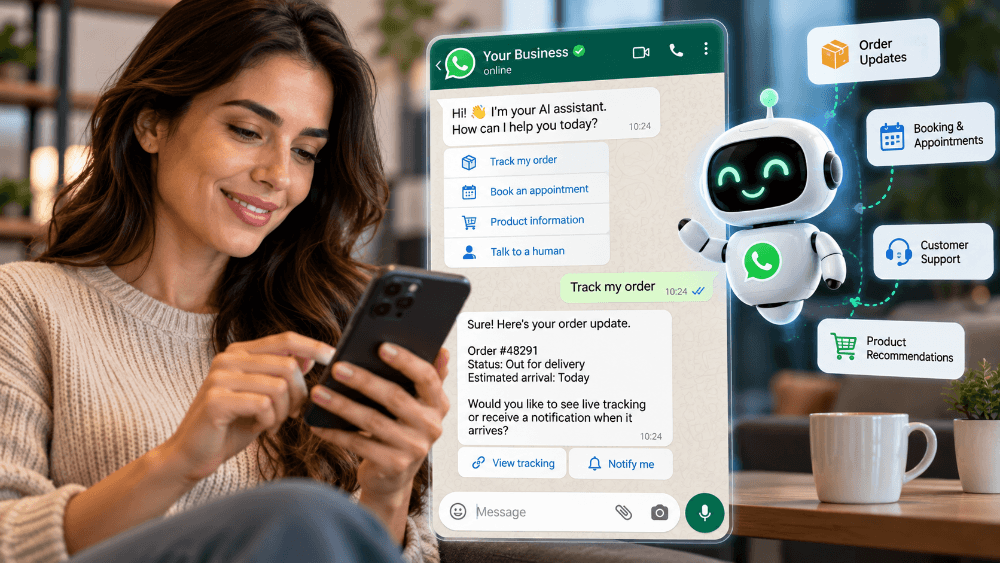
The Best Customer Service Will Feel Like One Continuous Conversation
The future of customer service texting will combine automation and human support rather than forcing businesses to choose between them.
AI agents will respond instantly, answer routine questions, gather information, and complete increasingly complex tasks.
Meanwhile, human agents will remain essential for exceptions, judgment, empathy, and high-stakes conversations.
The biggest challenge will be connecting the two.
Customers should not have to repeat their information, restart conversations, or navigate complicated menus simply because responsibility moved from AI to a person.
Therefore, the strongest customer service systems will make the technology invisible.
Customers will ask for help, get the right response, and move naturally between automation and human expertise when needed.
Ultimately, seamless conversations—not AI alone—will define the future of customer service texting.