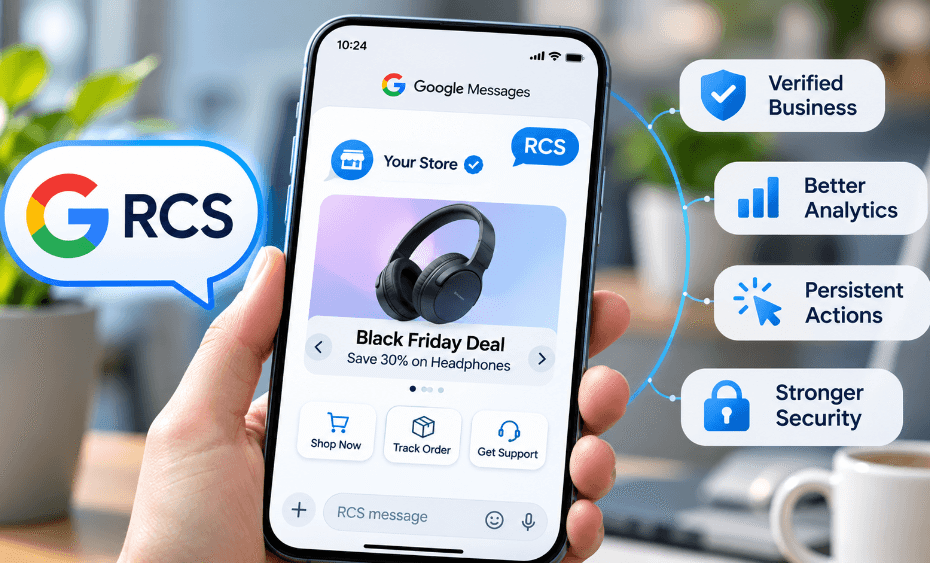
Google has made RCS for Business significantly more mature throughout 2026. The changes go far beyond richer message design. They affect analytics, billing visibility, verification, unsubscribe reporting, message reliability, branding, security, and the way businesses build interactive customer journeys.
Moreover, the broader RCS ecosystem has reached an important milestone. End-to-end encrypted RCS started rolling out between supported Android and iPhone devices in May 2026, while the GSMA released Universal Profile 4.1 during the summer to strengthen interoperability and security across networks.
Therefore, businesses should no longer view RCS as an experimental alternative to SMS. Instead, it is becoming a more serious part of mobile messaging strategy, especially for brands that want richer interactions without forcing customers into a separate app.
Partner Billing Reports Improve RCS Cost Visibility
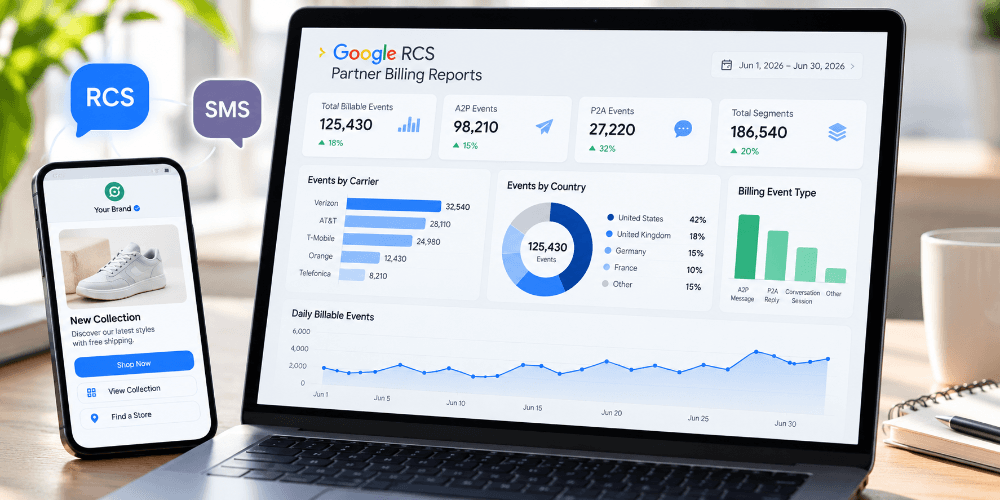
One of Google’s most important business-facing updates arrived in August 2026 with the introduction of partner billing reports.
These reports provide aggregated daily counts of billable RCS events grouped by agent, event type, and carrier. Google delivers the reports as CSV files through its secure SFTP service.
For messaging providers and large businesses, this creates better operational visibility.
Teams Can Now Analyze:
- Billable events by agent
- Traffic by carrier
- Different event types
- Daily billing activity
- Changes in messaging volume
Previously, businesses often relied heavily on internal logs or provider-level reporting to understand RCS costs. However, Google’s new billing reports create another structured data source for reconciliation.
That does not mean the reports replace campaign analytics.
A billing event does not tell marketers whether a customer purchased, booked an appointment, or completed a support interaction. Therefore, businesses should combine Google’s billing data with CRM, ecommerce, and campaign data to understand both cost and performance.
Unsubscribe Analytics Are Becoming More Useful
Google has also expanded unsubscribe reporting throughout 2026.
In February, the RCS Business Messaging API added new agent-performance fields covering unsubscribe reasons and spam-trend data. Then, in July, Google expanded unsubscribe metrics in the RCS for Business Developer Console to include non-promotional agents instead of displaying “N/A.”
More recently, on October 30, Google updated the unsubscribe experience inside Google Messages.
Customers Now See Clearer First-Person Reasons Such As:
- Too many messages
- I never signed up for this
- I’m no longer interested
- This looks like a scam
- Other
Google also randomizes the first four options to reduce selection bias while still reporting the feedback in the Analytics overview.
For businesses, this is more valuable than simply seeing an unsubscribe count.
For example, “Too many messages” suggests a frequency problem. Meanwhile, “I never signed up for this” points toward a consent or data-quality issue.
Therefore, marketers can use unsubscribe feedback as a diagnostic tool rather than treating opt-outs as one generic metric.
Persistent Suggestions Make Text Messages More Actionable
In May 2026, Google introduced persistent suggestions for standalone RCS text messages.
Traditional suggested actions can disappear after the conversation continues. Persistent suggestions stay inside the message bubble, which allows customers to return to important actions later.
For Example, a Business Might Include Persistent Buttons For:
- Open website
- Call support
- View location
- Track order
Google allows up to four persistent suggestions inside a standalone text message, while a message can contain up to 11 total suggestions when persistent and transient options are combined.
This change can improve customer journeys because useful actions no longer disappear as soon as another message arrives.
However, support currently varies by client. Google lists compatible versions of Google Messages, while iOS and Samsung Messages do not support the feature in the same way.
Therefore, businesses should still design fallback experiences for users who cannot access every RCS feature.
Google Is Making URLs More Transparent
Google also changed how links appear inside RCS suggested actions.
Beginning in March 2026, Google Messages started showing the destination URL directly inside “Open a URL” actions used in rich cards and carousels. Later, persistent URL suggestions followed the same transparency principle.
This may look like a small user-interface update, but it has important implications.
Unknown links create hesitation. A customer may be less willing to tap a button if they cannot tell where it leads.
By exposing the destination URL, Google aims to increase user confidence.
Therefore, brands should audit their links carefully.
Long tracking URLs, unrelated domains, or generic short links may now create a weaker experience. Businesses should use recognizable branded domains wherever possible.
Branding and Verification Are More Visible
Google updated RCS for Business branding in April 2026.
Verified agents now display a verification checkmark inside Google Messages, while agent logos use a rounded-square format throughout the conversation interface.
The verification checkmark can help customers distinguish legitimate business conversations from unknown senders.
As a result, verification is increasingly part of the customer experience rather than simply an administrative requirement.
Google has also improved the verification workflow itself.
Partners can upload supporting PDF documents directly through the Business Communications API or Developer Console. The platform supports up to five files per agent, each up to 50 MB.
Furthermore, Google says verification tokens will become mandatory for certain carrier launches in the future. Existing agents may also need valid tokens to avoid degraded verification experiences.
Businesses should therefore prepare verification processes now instead of waiting for enforcement.
Cross-Platform RCS Security Improved Dramatically
The largest ecosystem-level change in 2026 involves encryption.
On May 11, Google and Apple began rolling out end-to-end encrypted RCS messaging between supported Android and iPhone devices. The beta rollout applies to iPhones running iOS 26.5 with participating carriers and Android devices running current versions of Google Messages.
When encryption is active, users see a lock icon, and messages cannot be read while traveling between devices.
The GSMA later published RCS Universal Profile 4.1, which refined the technical foundation for cross-platform encryption and interoperability. The update also introduced improvements designed to strengthen network efficiency and consistency.
For businesses, stronger consumer confidence in RCS can indirectly increase channel adoption.
However, brands should avoid assuming that every business message automatically receives the same end-to-end encryption treatment as a person-to-person chat. Business messaging architectures, carrier support, and client capabilities still vary.
Therefore, companies should review the security model of their specific RCS provider and use case.
Message Delivery and Expiration Rules Are Becoming More Reliable
Google has also made technical changes designed to improve message reliability.
On October 29, 2026, the platform introduced a minimum six-second expiration for agent messages that use a TTL or explicit expiration time.
If a business specifies an expiration below six seconds, Google automatically extends it. Meanwhile, zero or negative expiration values now generate an error.
The goal is to prevent situations where extremely short-lived messages expire before carrier networks and devices can process delivery and return receipts.
Therefore, businesses that use time-sensitive RCS messages should review their fallback logic.
Google specifically recommends waiting for the revocation webhook before triggering fallback and adding a small buffer so late delivery receipts can settle.
For high-volume transactional programs, this can reduce duplicate deliveries between RCS and SMS fallback channels.
Regional Capability Checks Are Now More Structured
Another important technical change affects batch capability checks.
Since May 2026, Google requires users.batchGet requests to use the regional API endpoint that matches the phone numbers in each batch. Mixed-region batches or requests sent to the wrong endpoint can fail with a 400 error.
This means businesses and messaging providers need stronger geographic routing logic.
However, the change can also improve resilience and performance because regionalized infrastructure reduces the impact of disruptions and keeps traffic closer to the appropriate systems.
Therefore, companies operating internationally should review how they group and route capability checks.
Agent Launching and Governance Are Getting Easier to Audit
Google introduced several 2026 updates around agent operations and governance.
For example, the RBM Operations API now supports an optional acting_party field when changing launch status. That identifier appears in agent history and webhook notifications, which gives businesses a clearer audit trail.
Google also introduced a new webhook header calledX-Goog-Webhook-Type, making it easier for developers to identify incoming webhook requests without first parsing the full JSON payload.
Additionally, Google made agent-preview videos optional for Google-managed launches in October. Businesses can now submit detailed written transcripts describing triggers, conversation flows, suggested actions, and opt-out behavior instead.
Consequently, onboarding may become faster for teams that already maintain good messaging documentation.
Promotional Messaging Faces Stronger Reputation Controls
Google is also becoming more aggressive about controlling promotional traffic.
In January 2026, Google introduced new RCS traffic limits for promotional agents in India based on agent reputation. Then, in April, it added cross-agent limits that restrict the combined number of promotional messages users can receive from low-reputation agents.
The message for marketers is clear: sender reputation matters more and more.
Businesses Should Monitor:
- Unsubscribe rates
- Spam feedback
- Message frequency
- Engagement quality
- Consent accuracy
- Campaign relevance
So sending more RCS messages doesn’t necessarily create more reach.
Poor engagement and user complaints can eventually restrict delivery opportunities.
What Should Businesses Do With These RCS Updates?
The 2026 changes show that Google is developing RCS for Business in several directions at once.
Brands should prioritize five practical actions:
- Review unsubscribe feedback instead of tracking opt-outs alone.
- Audit destination URLs and brand presentation.
- Prepare verification documents and token support.
- Connect billing reports with campaign analytics.
- Test fallback logic across RCS and SMS carefully.
Additionally, businesses should review whether interactive features such as persistent suggestions can improve existing customer journeys.
For example, an order notification could keep a “Track Order” button visible, while an appointment reminder could preserve a “Call Us” or “View Location” action.
Google RCS Is Becoming a More Mature Business Channel
Google’s 2026 RCS updates reveal a clear direction.
The platform is becoming more measurable, transparent, secure, and operationally sophisticated.
Partner billing reports improve cost visibility. Unsubscribe analytics provide better customer feedback. Persistent suggestions create more useful interactions. Verification checkmarks strengthen brand identity. Meanwhile, cross-platform encryption and Universal Profile improvements strengthen the wider RCS ecosystem.
At the same time, Google is tightening expectations around reputation, verification, traffic management, and technical reliability.
Therefore, businesses should not treat RCS simply as “SMS with images.”
RCS is evolving into a distinct business messaging channel with its own analytics, user-experience standards, operational requirements, and interactive capabilities.
The brands that benefit most will be those that use those capabilities intentionally—creating messages that feel more useful, trustworthy, and actionable, not just more visually impressive.