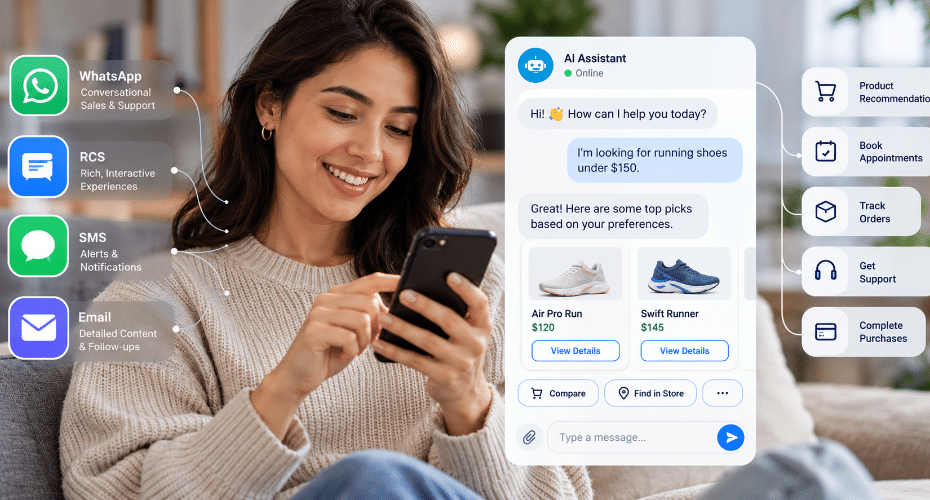
Business messaging is moving beyond simple notifications and promotional texts. Customers increasingly expect to ask questions, receive personalized recommendations, manage orders, and complete tasks without leaving the conversation.
At the same time, artificial intelligence is making those interactions easier to automate. RCS is bringing richer functionality to native messaging, while WhatsApp continues to expand as a major business communication channel.
Therefore, the future of business messaging will not revolve around a single platform. Instead, brands will combine AI agents, conversational interfaces, customer data, and multiple messaging channels to create faster and more useful customer journeys.
Messaging Is Becoming a Customer Experience Platform
For years, businesses mainly used messaging to send information. An SMS might confirm an appointment, provide a delivery update, or advertise a sale.
However, modern messaging can support the entire customer journey.
A customer can discover a business, ask questions, compare products, schedule an appointment, complete a purchase, receive order updates, and request support without switching between several unrelated systems.
This shift changes how brands should think about messaging. Instead of treating it as another campaign channel, businesses can use it as a customer-experience layer.
Moreover, Meta reported in 2026 that more than one billion active business conversation threads occur across WhatsApp, Messenger, and Instagram every day. That scale demonstrates how naturally customers have adopted messaging for commercial interactions.
AI Agents Will Move From Chatbots to Action-Taking Assistants
Traditional chatbots usually follow predefined scripts. They recognize keywords, display menu options, and provide fixed answers.
AI agents can go much further.
An agent can understand natural-language questions, access connected systems, evaluate context, and take approved actions. For example, a customer could write:
“Can I move my appointment to Friday afternoon?”
Instead of simply providing a scheduling link, an AI agent could check availability, suggest suitable times, confirm the new appointment, and update the calendar.
Businesses Can Increasingly Use AI Agents To:
- Answer product questions
- Recommend products
- Qualify leads
- Schedule appointments
- Retrieve order information
- Process routine requests
- Route complex conversations
- Support purchasing decisions
Meta said in June 2026 that more than one million businesses were already using its Business Agent across WhatsApp and Messenger. The platform can also connect to external systems such as Shopify and Zendesk, allowing agents to act on real business data.
Therefore, the biggest change isn’t better automated replies. It is messaging systems’ ability to complete tasks.
Human Support Will Still Matter
AI agents will automate more conversations, but customers will not want every interaction handled by a machine.
Some situations require judgment, empathy, negotiation, or authority. A complicated refund dispute, repeated service failure, or sensitive account problem may need a human employee.
Therefore, the strongest systems will use a hybrid approach.
AI can handle predictable questions and gather relevant information first. Then, when escalation becomes necessary, the employee can enter the conversation with the customer’s context already available.
This model improves efficiency without leaving customers at a dead end.
Moreover, businesses should clearly define what AI agents can and cannot do. Agents should not invent discounts, change important account settings without authorization, or provide uncertain information simply to keep the conversation moving.
RCS Will Make Native Messaging More Interactive
RCS, or Rich Communication Services, expands what brands can deliver within the phone’s native messaging environment.
Instead of plain text and links, RCS can support richer content such as:
- High-quality images
- Product cards
- Carousels
- Suggested replies
- Action buttons
- Branded business profiles
- Read receipts
- Interactive customer journeys
As a result, brands can create experiences that feel closer to an app while staying within the messaging interface.
For example, a retailer could send a carousel of recommended products. A hotel could present check-in options, directions, and customer support buttons. Meanwhile, an airline could combine flight information with actions for check-in or schedule changes.
Cross-platform RCS has also continued to mature. In 2026, Apple and Google began rolling out end-to-end encrypted RCS between supported iPhone and Android devices, while carrier availability continued expanding.
As a result, RCS will become increasingly relevant to brands that want richer mobile messaging without forcing customers into a separate application.
SMS Will Remain the Reliable Fallback
RCS may offer more features, but SMS will not disappear.
SMS remains valuable because it reaches an enormous range of mobile devices and requires very little from the recipient. Customers don’t need a specific app, account, or advanced smartphone experience.
Therefore, businesses will increasingly use layered delivery logic.
A campaign might send an RCS experience to supported users and automatically fall back to SMS when RCS is unavailable.
This approach lets brands improve the experience without sacrificing reach.
Consequently, the future is less likely to become “RCS versus SMS” and more likely to become “RCS with SMS underneath it.”
WhatsApp Will Continue Driving Conversational Commerce
WhatsApp already sits much closer to the conversational-commerce model.
Customers use it naturally for back-and-forth interaction, while businesses can combine messaging with product recommendations, support, appointments, and marketing.
Commercial activity around the platform continues to expand. Meta reported that paid WhatsApp messaging had surpassed a $2 billion annual run rate by late 2025, while U.S. click-to-message advertising revenue grew more than 50% year over year during the same quarter.
As a result, brands increasingly view WhatsApp not simply as a support tool but as a sales channel.
A Conversational Commerce Journey Might Look Like This:
- Customer clicks a social advertisement.
- WhatsApp opens automatically.
- An AI agent asks what the customer needs.
- The customer describes preferences.
- The agent recommends suitable products.
- The customer asks follow-up questions.
- The business provides a purchase path.
- The same conversation later handles support.
The result is a shorter journey between interest and action.
Conversational Commerce Will Reduce Website Friction
Traditional ecommerce often requires customers to navigate several pages before completing a purchase.
Messaging can remove many of those steps.
For example, someone looking for a particular product may not want to browse dozens of categories, compare specifications manually, and search through FAQs.
Instead, the customer can simply ask:
“I need waterproof running shoes under $150. What do you recommend?”
An AI-assisted messaging system can narrow the options immediately.
As a result, product discovery becomes conversational rather than navigational.
This change could be especially important for complex products, services, travel, appointments, and purchases where customers often need advice before deciding.
Customer Data Will Power More Relevant Conversations
AI agents and conversational commerce depend heavily on customer context.
A useful agent should understand whether the customer recently purchased, has an active support ticket, belongs to a loyalty program, or previously expressed a product preference.
Therefore, businesses will increasingly connect messaging with:
- CRM data
- Ecommerce platforms
- Customer support systems
- Inventory
- Loyalty programs
- Appointment systems
- First-party behavioral data
Without those connections, AI may produce technically correct but contextually poor responses.
For example, an agent might recommend a product the customer already purchased yesterday.
Consequently, customer data quality may become as important as AI model quality.
Omnichannel Orchestration Will Become More Intelligent
Customers do not always prefer the same messaging channel.
One person may prefer SMS for urgent delivery alerts but WhatsApp for customer support. Another may respond better to RCS product experiences while still relying on email for detailed receipts.
As a result, businesses will increasingly use intelligent routing.
| Customer Need | Possible Best Channel |
|---|---|
| Urgent alert | SMS |
| Interactive product discovery | RCS |
| Two-way sales conversation | |
| Detailed documentation | |
| Automated support | AI agent across messaging channels |
AI can eventually help select the channel based on urgency, cost, customer preference, past engagement, and availability.
However, customer consent must always override optimization. A system should never choose a channel the customer has opted out of simply because it predicts a higher conversion rate.
Messaging Analytics Will Shift Toward Conversation Outcomes
Businesses have traditionally measured messaging through sends, delivery rates, clicks, and conversions.
Conversational commerce requires broader metrics.
Brands will increasingly measure:
- Conversation-start rate
- Resolution rate
- Qualified leads
- Revenue per conversation
- Appointment bookings
- AI-to-human escalation rate
- Time to resolution
- Customer satisfaction
- Incremental conversion lift
Businesses should also evaluate whether automation genuinely reduces customer effort.
A long AI conversation may technically count as engagement, but if the customer needed ten messages to solve a simple problem, the experience still failed.
Therefore, conversation quality will matter as much as volume.

The Future of Business Messaging Is Conversational
The next phase of business messaging will not revolve around sending more notifications.
Instead, brands will focus on helping customers accomplish things inside conversations.
AI agents will understand requests and take actions. RCS will bring richer experiences to native messaging. WhatsApp will continue expanding conversational commerce. Meanwhile, SMS will provide reliable reach and fallback coverage.
Most importantly, these technologies will increasingly work together.
Successful businesses won’t ask which single messaging channel should replace the others. Instead, they will build connected systems where customer context travels across channels, and every conversation continues from where the last one ended.
Ultimately, the future of business messaging isn’t about the messages themselves.
It is about turning conversations into useful customer experiences—and, when appropriate, into sales.