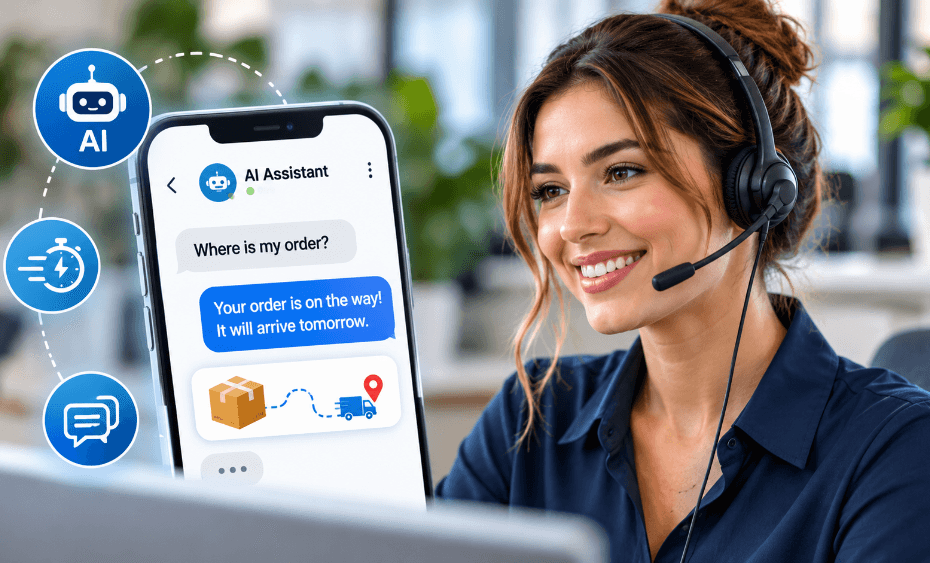
Customers increasingly expect fast answers when they text a business. Unlike email, SMS feels immediate. So a delayed response can quickly create frustration, especially when a customer asks about an order, appointment, payment, or urgent service issue.
Artificial intelligence can help businesses close that response-time gap.
AI-powered SMS customer support can answer common questions, retrieve information, classify requests, route conversations, and assist human agents before a customer ever reaches a traditional support queue. As a result, businesses can handle more conversations without forcing every request through the same manual process.
However, speed alone does not create good customer service. AI needs accurate data, sensible escalation rules, and human support for situations that require judgment or empathy.
The goal should not simply be faster replies. Instead, businesses should use AI to resolve issues faster.
Why Response Time Matters So Much in SMS Support
Text messaging creates unusually high expectations around speed because customers already interact with SMS in near real time.
EZ Texting’s 2026 Consumer Texting Behavior Report found that 87% of surveyed consumers check a new text within 15 minutes. Moreover, 82% respond within 15 minutes, while nearly 70% expect a business to reply within one hour.
Therefore, a company that invites customers to text but responds several hours later may create a mismatch between the channel and the customer experience.
SMS support works best when businesses design operations around this expectation. AI can help by responding immediately instead of leaving every message unread until an employee becomes available.
What Is AI-Powered SMS Customer Support?
AI-powered SMS support combines text messaging with artificial intelligence that interprets customer messages and determines the next step.
Traditional SMS automation usually relies on keywords.
For example:
Customer: “HOURS”
System: “We are open Monday through Friday from 9 AM to 6 PM.”
That approach works for predictable requests. However, customers rarely phrase real questions in exactly the same way.
An AI system can understand messages such as:
“Are you guys still open after 5 today?”
or:
“I placed an order three days ago. Can you tell me when it will arrive?”
Therefore, AI can make automated SMS support feel more flexible and conversational.
AI Can Provide an Immediate First Response
One of the simplest ways AI reduces response time is by eliminating the initial wait.
Instead of leaving a customer in a queue, the AI can acknowledge the request immediately, understand the issue, and begin gathering information.
Twilio’s research on conversational AI found that 92% of consumers say AI typically responds within 30 seconds. As a result, customers already associate AI support with extremely fast replies.
However, that also raises the bar. Customers may tolerate waiting several minutes for a human, but they expect AI to respond almost immediately.
Therefore, businesses should use AI where rapid acknowledgment adds real value, not just because the technology exists.
AI Can Automatically Identify What the Customer Needs
A major source of delay in customer support is routing.
A customer may send a message about a refund, a product question, a billing issue, or an appointment request. Traditionally, an employee must read the message and decide which team should handle it.
AI can perform that classification instantly.
For Example, It Might Identify:
- Order-status requests
- Shipping problems
- Appointment changes
- Product questions
- Refund requests
- Billing issues
- Sales inquiries
- Technical problems
Then, the system can either handle the request automatically or route it to the correct person.
As a result, customers spend less time moving between departments.
Routine Questions Can Be Resolved Without a Queue
Many support conversations involve straightforward information that already exists inside business systems.
AI can retrieve that information and answer directly when integrations are available.
| Customer Question | Possible AI Action |
|---|---|
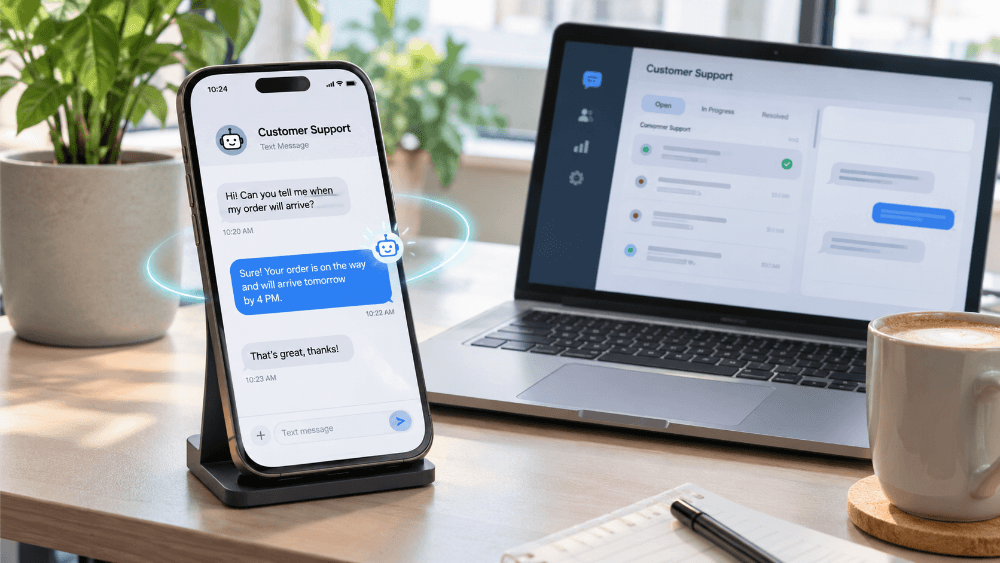
| “Where is my order?” | Retrieve tracking information |
| “Can I move my appointment?” | Check available times |
| “Is this item in stock?” | Check inventory |
| “What is your return policy?” | Retrieve approved policy |
| “Did my payment go through?” | Check transaction status |
| “Do you have this in medium?” | Check product availability |
As a result, human employees don’t need to answer the same routine questions repeatedly.
This approach also gives customers useful answers outside normal office hours.
A customer texting at 10 PM may not need a support agent if the AI can accurately provide delivery information or appointment availability.
AI Can Gather Information Before Human Handoff
Not every problem should be resolved automatically.
However, AI can still reduce response time before transferring the conversation to a person.
Suppose a customer writes:
“My package arrived damaged and I need a replacement.”
Before Escalation, the AI Could Ask For:
- The order number
- The damaged item
- A brief description of the problem
- A photo, if the messaging setup supports it
Then, when the human agent receives the conversation, much of the information required to solve the issue already exists.
As a result, the employee can start working on the solution instead of starting from zero.
Context Is Critical During AI-to-Human Handoffs
Poor handoffs can eliminate most of the time AI saved.
Customers become frustrated when they explain an issue to an automated assistant and then hear:
“Can you tell me what happened?”
Twilio’s conversational AI research found that only 15% of consumers say they have experienced a seamless AI-to-human handoff. Moreover, 54% say AI agents rarely or never have previous context about them.
Therefore, businesses should pass conversation history, customer details, detected intent, and actions already attempted to the human employee.
A good escalation should feel like continuing the same conversation, not starting a new support ticket.
AI Should Know When to Escalate
Businesses should not measure AI success by how many customers it prevents from reaching a human.
Instead, they should measure whether the customer actually gets the issue resolved.
Twilio warns that containment metrics can become misleading because a conversation may appear “contained” when a frustrated customer simply stops responding.
Therefore, AI systems need clear escalation triggers.
Common Triggers May Include:
- Customer explicitly asks for a person
- AI confidence falls below a defined threshold
- Customer repeats the same question
- Negative sentiment increases
- The issue involves a large refund
- Sensitive account information appears
- The request falls outside approved workflows
Furthermore, the AI should not argue with customers who request human support.
Recent Twilio research found that 78% of consumers try to bypass AI agents to reach a person. That indicates businesses still need to make escalation easy and transparent.
AI Can Help Human Agents Respond Faster Too
AI does not need to speak directly with customers to improve SMS support.
It can also work behind the scenes.
For example, AI can:
- Summarize long conversation histories
- Suggest responses
- Retrieve relevant policies
- Highlight customer sentiment
- Identify previous purchases
- Recommend next actions
- Translate customer messages
- Classify urgency
As a result, a human agent can spend less time searching through systems and more time solving the customer’s problem.
This approach may be particularly useful for complex support cases where businesses want employees to remain in control of every customer-facing response.
Smart SMS Support Needs Reliable Customer Data
AI cannot provide useful answers if it cannot access accurate information.
For example, a system might tell a customer an order hasn’t shipped if its shipping data hasn’t been updated. Likewise, it might recommend an appointment time that someone else already booked.
Therefore, AI-Powered SMS Support Should Connect With Relevant Systems Such As:
- CRM platforms
- Ecommerce systems
- Order databases
- Appointment software
- Inventory systems
- Customer-service platforms
- Billing systems
Moreover, businesses should control what information the AI can access.
Customers may appreciate personalized service, but they may also feel uncomfortable if an automated agent appears to know unnecessary personal details.
Automation Does Not Remove SMS Compliance Requirements
AI-powered support still operates within the same messaging environment as other business texts.
Therefore, businesses need to maintain appropriate consent and opt-out controls.
A customer who texts support does not automatically consent to promotional messaging. Likewise, an AI agent should not add customers to a marketing campaign because they asked a service question.
Businesses should also recognize unsubscribe requests, including natural language such as:
- “Stop texting me”
- “Remove me”
- “No more messages”
- “Please unsubscribe me”
Consequently, compliance controls should sit at the platform level rather than rely entirely on an AI model to interpret the request correctly.
What Should Businesses Measure?
Fast replies are useful, but first-response time alone can create the wrong incentives.
Businesses should measure whether customers actually reach satisfactory outcomes.
Useful AI SMS support metrics include:
- First-response time
- Average resolution time
- Resolution rate
- Human escalation rate
- Messages per resolution
- Customer satisfaction
- Repeat contact rate
- AI accuracy
- Opt-out rate
- Abandonment rate
- Cost per resolved conversation
Teams should also review conversation samples regularly.
An AI agent could respond in five seconds while still giving confusing or repetitive answers. Twilio found that 40% of consumers report AI repeating itself or getting stuck in loops, while 66% say AI does not always understand what they are asking.
Therefore, speed and quality need to improve together.
How to Start With AI-Powered SMS Support
Businesses should begin with narrow, predictable workflows.
Good starting points include:
- Order-status questions
- Appointment scheduling
- Store hours
- Basic product availability
- Delivery notifications
- Simple return instructions
Then, businesses can expand automation after reviewing accuracy and customer feedback.
Also, define escalation rules before launch, not after problems appear.
Most importantly, connect the AI to verified information. A support agent that answers instantly but incorrectly creates more work, not less.
Faster Support Should Lead to Faster Resolution
AI-powered SMS customer support can dramatically reduce the time between a customer’s question and the first useful action.
It can respond immediately, classify requests, retrieve information, gather details, route conversations, and support human employees.
However, the real opportunity goes beyond speed.
Customers want accurate answers and simple resolutions. So businesses shouldn’t judge AI by how quickly it sends a message or how many conversations it keeps away from human agents.
The strongest systems combine AI speed with reliable data and human judgment.
When businesses get that combination right, smart texting can reduce response times while also making customer support easier, more scalable, and more useful.