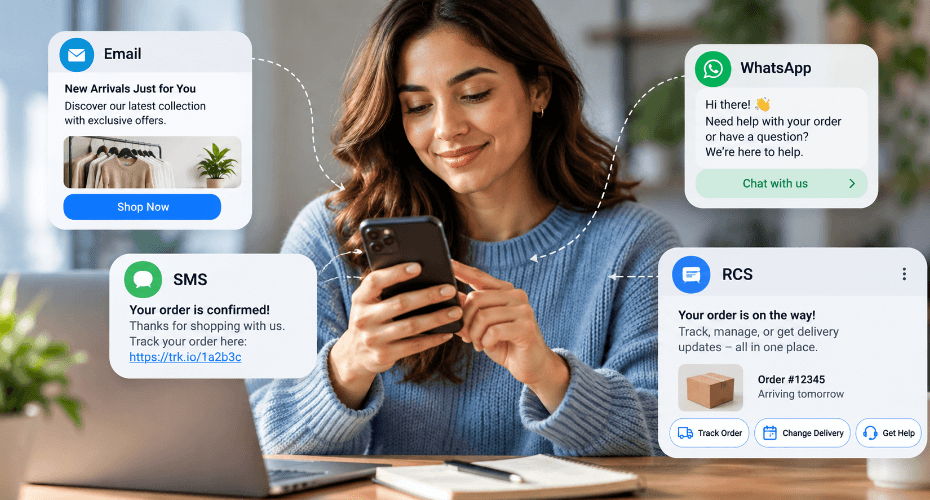
Customers rarely interact with a brand through only one channel. They may discover a product via email, get an SMS reminder, ask a question on WhatsApp, and later receive an RCS update with interactive options.
Therefore, businesses need more than a multichannel presence. They need an omnichannel messaging strategy that connects those interactions into one coherent customer journey.
The difference matters. Multichannel messaging simply means using several channels. Omnichannel messaging coordinates those channels around the same customer, shared data, and shared goals.
Recent consumer research reinforces this need. Twilio reports that 87% of consumers use multiple channels for branded communication. Email remains widely preferred, while text messaging and WhatsApp show especially big regional and use-case differences.
As a result, the best strategy isn’t to choose SMS, WhatsApp, email, or RCS as the single winner. Instead, brands should give each channel a specific role.
What Is an Omnichannel Messaging Strategy?
An omnichannel messaging strategy coordinates communication across multiple channels while maintaining customer context.
For example, imagine a shopper leaves products in a cart.
A disconnected multichannel approach might send:
- An email about the abandoned cart
- An SMS with the same discount
- A WhatsApp message repeating the offer
- An RCS promotion showing the same products
That creates repetition rather than personalization.
An omnichannel system works differently.
It may send an email first because email can provide more product detail. If the shopper does not act and has opted into SMS, the system may send a short reminder later. If the customer completes the purchase, the system automatically stops all remaining reminders.
Therefore, omnichannel strategy focuses on orchestration rather than message volume.
Give Each Messaging Channel a Clear Role
Every channel has different strengths. Consequently, brands should match the channel to the message’s purpose instead of duplicating campaigns everywhere.
| Channel | Best Use |
|---|---|
| Detailed content, newsletters, receipts and long-form promotions | |
| SMS | Urgent alerts, reminders, short offers and broad mobile reach |
| Conversations, customer support, recommendations and global engagement | |
| RCS | Rich branded experiences, product discovery and interactive journeys |
This division is not absolute. However, it provides a practical starting point for campaign planning.
Email Works Best for Depth
Email remains one of the most versatile customer communication channels.
Brands can include multiple products, detailed explanations, images, educational content, account information, and complex layouts. Moreover, email works especially well for messages customers do not need to act on immediately.
Twilio’s recent communications research found that 75% of surveyed consumers ranked email among their top three preferred branded communication channels globally. In retail specifically, that figure reached 79%.
Therefore, email should often carry the detailed version of a campaign.
For example, a retailer could introduce an entire seasonal collection by email. Then, SMS or RCS can provide more focused follow-up messages later.
Use SMS When Timing Matters
SMS offers speed, simplicity, and broad reach across mobile devices.
Therefore, it works particularly well for urgent or concise communication such as:
- Appointment reminders
- Delivery notifications
- Flash sales
- Security alerts
- Payment reminders
- Abandoned-cart nudges
- Event changes
Consumer preferences also reflect that strength. Twilio found that text messaging, including SMS, MMS, and RCS, ranked highly for time-sensitive notifications and authentication use cases.
However, SMS should not become the default channel for every campaign.
Because texts feel immediate and personal, excessive promotional messaging can quickly create fatigue. As a result, brands should reserve SMS for situations where speed or visibility genuinely adds value.
Use WhatsApp for Conversations
WhatsApp works differently from email and traditional SMS because customers already expect conversational interaction inside the platform.
Therefore, brands can use WhatsApp to:
- Answer product questions
- Qualify leads
- Schedule appointments
- Provide order support
- Recommend products
- Send approved marketing messages
- Continue conversations after ads
Regional preference matters significantly.
Twilio’s research found that WhatsApp ranked among the top three preferred branded channels for 57% of consumers globally, but that figure increased to 84% in Latin America. By contrast, North American preference remained much lower.
Therefore, global businesses should not assume one messaging mix will work equally well everywhere.
Meta has also been more closely connecting WhatsApp to its wider advertising ecosystem. Businesses can manage campaigns across WhatsApp, Facebook, and Instagram through Ads Manager and use centralized audience and budget tools.
As a result, WhatsApp can connect marketing acquisition directly with customer conversation.
Use RCS When Interaction Improves the Experience
RCS adds richer capabilities to native mobile messaging.
Google’s RCS for Business supports text, media, rich cards, carousels, suggested replies, and suggested actions. These actions can help customers open links, share locations, create calendar events, or navigate through guided journeys.
Therefore, RCS works well when customers need to explore or choose.
For example, a travel company could send an RCS message that includes:
- Flight information
- Check-in action
- Seat-selection link
- Airport location
- Customer support option
Likewise, a retailer could show several products in a carousel instead of sending customers to a generic landing page.
However, RCS support still varies by device, carrier, and market. Therefore, SMS fallback remains important.
Coordinate Channels Around Customer Intent
The central principle of omnichannel messaging is simple: customer behavior should determine what happens next.
Suppose a customer browses a product but does not purchase.
A coordinated journey might look like this:
- Email provides product details and reviews.
- SMS sends a concise reminder several hours later.
- RCS displays related products when supported.
- WhatsApp handles questions if the customer starts a conversation.
- The system stops every promotional reminder after purchase.
As a result, channels complement one another instead of competing.
This also reduces the risk of customers receiving the same promotion four times.
Omnichannel messaging becomes difficult when customer information sits in separate systems.
For example, email software may know that the customer clicked a campaign, while the SMS platform does not know that the customer already purchased.
As a result, disconnected systems can send irrelevant messages.
Businesses should connect messaging platforms with customer information such as:
- Consent status
- Purchase history
- Browsing behavior
- Loyalty status
- Support interactions
- Channel preferences
- Previous campaign engagement
Twilio describes unified customer profiles and real-time data as central elements of effective omnichannel engagement because they help businesses maintain context as customers move between channels.
Therefore, data integration should come before advanced automation.
Let Customers Influence Channel Selection
A good omnichannel strategy does not simply choose channels based on what marketers prefer.
Customers should also influence the decision.
Businesses can ask subscribers which communication channels they prefer and what types of messages they want through each
For Example:
- SMS for delivery updates
- Email for promotions
- WhatsApp for support
- RCS for interactive order communication
Moreover, channel preference can change according to message type.
A customer who dislikes promotional SMS may still strongly prefer text messages for fraud alerts or appointment reminders.
Therefore, preference centers should capture both channel and purpose.
Avoid Sending the Same Message Everywhere
One of the biggest omnichannel mistakes is sending the same message everywhere at once
If a customer receives identical promotional content through email, SMS, WhatsApp, and RCS within an hour, the experience does not feel coordinated. It feels aggressive.
Instead, define channel priority and fallback logic.
For example:
- Promotion: Email first → SMS only for highly engaged subscribers.
- Urgent delivery issue: SMS first → email with additional information.
- Interactive product launch: RCS where available → SMS fallback.
- Customer question: Continue in WhatsApp once the conversation starts.
This approach reduces repetition while making each channel useful.
Use AI to Improve Channel Orchestration
Artificial intelligence can help businesses decide not only what message to send, but also where and when.
AI systems can analyze:
- Previous channel engagement
- Purchase history
- Customer location
- Message urgency
- Time of day
- Recent interactions
- Cost per channel
- Likelihood of conversion
Therefore, one customer might receive an SMS while another receives the same campaign by email.
However, AI should not override customer consent or channel preferences.
If a customer has opted out of promotional SMS, an optimization model should never reactivate that channel simply because SMS historically generated better engagement.
Measure the Whole Journey, Not Each Channel in Isolation
Traditional analytics often compare email against SMS or WhatsApp against RCS.
However, omnichannel journeys frequently involve several interactions before conversion.
For example, a customer might open an email, ignore an SMS, ask a question through WhatsApp, and then purchase through the website.
Which channel deserves credit?
The answer is rarely just one.
Therefore, Businesses Should Track Metrics Such As:
- Conversion rate across the journey
- Revenue per customer
- Cost per conversion
- Customer response rate
- Time to conversion
- Support resolution rate
- Opt-out rate by channel
- Incremental revenue
- Customer lifetime value
Moreover, holdout testing can help determine whether an additional channel genuinely improves results.
How to Build an Omnichannel Messaging Strategy
Businesses do not need to activate every channel immediately.
Instead, build the strategy in stages.
Start by mapping key customer journeys such as welcome, abandoned cart, purchase, delivery, customer support, and win-back.
Then:
- Identify the best channel for each message.
- Connect customer data across platforms.
- Centralize consent and preferences.
- Define channel priority and fallback rules.
- Add behavioral automation.
- Suppress messages after relevant customer actions.
- Test AI-based channel selection carefully.
- Measure customer outcomes rather than send volume.
Most importantly, keep the experience simple.
Omnichannel messaging should reduce customer effort, not create more noise.

The Best Omnichannel Strategy Feels Like One Conversation
Customers do not think in marketing channels.
They think about the brand.
Therefore, a customer shouldn’t have to explain the same issue again just because they moved from SMS to WhatsApp. Likewise, they shouldn’t receive an abandoned-cart email after completing a purchase through an RCS conversation.
The strongest omnichannel strategy makes SMS, WhatsApp, email, and RCS part of one customer relationship.
Email provides depth. SMS provides immediacy. WhatsApp supports conversation. RCS adds richer interaction.
Ultimately, the goal is not to use every channel as often as possible. It is to choose the right channel for the right message while maintaining customer context across the entire journey.