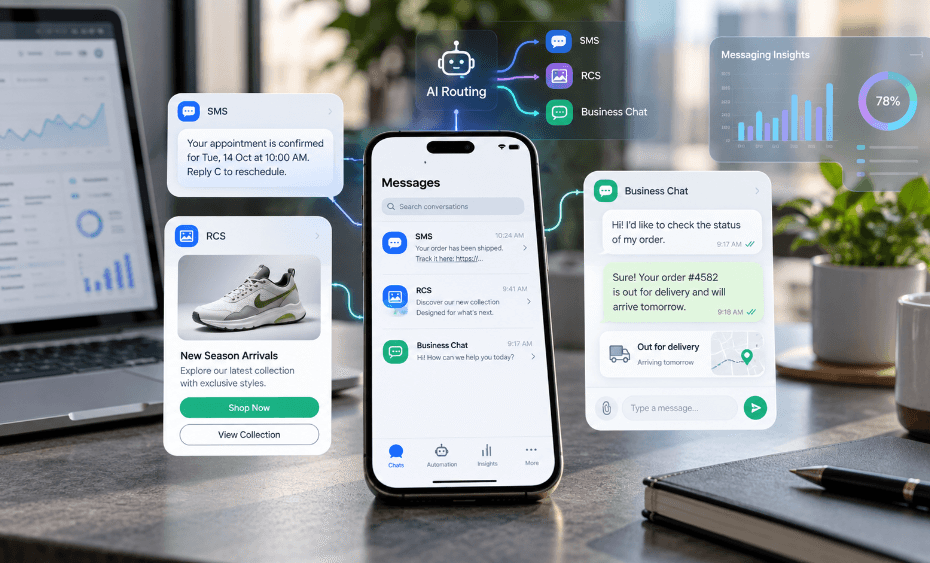
Application-to-Person messaging is entering a new phase. For years, businesses relied primarily on SMS to send one-time passwords, delivery alerts, appointment reminders, promotions, and other customer communications. However, the market now includes richer channels such as RCS and WhatsApp Business, along with increasingly sophisticated AI-powered messaging tools.
SMS will remain important in 2027 because of its reach and simplicity. Nevertheless, RCS is becoming more practical across smartphone ecosystems, while WhatsApp continues expanding as a major business communication channel. At the same time, AI agents are turning messaging from a notification system into a conversational customer experience.
Therefore, the biggest A2P messaging trend for 2027 won’t be one channel replacing another. Instead, businesses will increasingly combine several channels and choose the best one according to customer preference, message purpose, cost, and device capabilities.
What Is A2P Messaging?
A2P stands for Application-to-Person messaging. It describes messages that software applications send to individual mobile users rather than messages exchanged directly between two people.
Common A2P use cases include:
- One-time passwords and verification codes
- Banking and fraud alerts
- Order confirmations
- Shipping notifications
- Appointment reminders
- Promotional campaigns
- Account updates
- Customer support
- Reservation confirmations
- Payment notifications
Historically, most A2P traffic traveled through SMS. However, businesses now have several ways to reach customers.
As a result, A2P messaging is evolving from a single-channel market into an ecosystem that includes SMS, MMS, RCS, WhatsApp, and other conversational platforms.
1. SMS Will Remain the Foundation of A2P Messaging
Predictions about SMS’s decline appear regularly. However, businesses still rely heavily on it because almost every mobile phone can receive a text message.
SMS doesn’t require a specific app, customer account, or reliable mobile-data connection. As a result, it remains particularly valuable for urgent, transactional communication.
Businesses Will Continue Using Sms in 2027 For:
- OTP and authentication
- Security alerts
- Delivery notifications
- Appointment reminders
- Emergency communication
- Time-sensitive updates
However, SMS growth is becoming more challenging. Industry forecasts suggest global A2P SMS traffic may be approaching a plateau as businesses shift some messaging to WhatsApp, RCS, and other channels.
Additionally, international SMS pricing remains a concern in many markets. As carrier costs rise, companies increasingly evaluate whether another channel can deliver the same message more efficiently.
As a result, SMS may shift from the default option for every message to a reliable foundation within a broader messaging strategy.
2. RCS Will Move Closer to Mainstream Business Messaging
RCS may become one of the most important A2P developments in 2027.
Rich Communication Services extends traditional mobile messaging with capabilities such as:
- Verified brand identities
- High-resolution images and video
- Rich cards
- Product carousels
- Suggested replies
- Interactive buttons
- Read receipts
- Typing indicators
- Location sharing
Previously, fragmented device and carrier support slowed RCS adoption. However, Apple’s introduction of RCS support fundamentally improved its cross-platform potential.
The RCS ecosystem continued advancing throughout 2026. The GSMA released Universal Profile 4.1, strengthening interoperability, efficiency, privacy, and end-to-end encryption capabilities across devices and networks.
As a result, businesses entering 2027 can consider RCS for customer experiences that require more than a basic text notification.
3. RCS Business Messaging Will Focus on Interaction
RCS becomes most valuable when businesses use its interactive capabilities rather than simply recreating an SMS message with nicer visuals.
For example, a retailer could send a product carousel where customers browse several products directly inside the messaging interface.
Likewise, an Airline Could Provide Buttons For:
- Check in
- View boarding pass
- Change flight
- Contact support
As a result, messaging can become part of the customer journey instead of merely directing the recipient elsewhere
Businesses may increasingly use RCS for product discovery, appointment booking, travel updates, loyalty programs, and conversational customer service.
However, brands will still need fallback options. RCS availability depends on the recipient’s device, carrier, software, and connectivity.
As a result, SMS will often remain the backup channel.
4. WhatsApp Business Messaging Will Keep Expanding
WhatsApp has become a major business communication channel in many global markets.
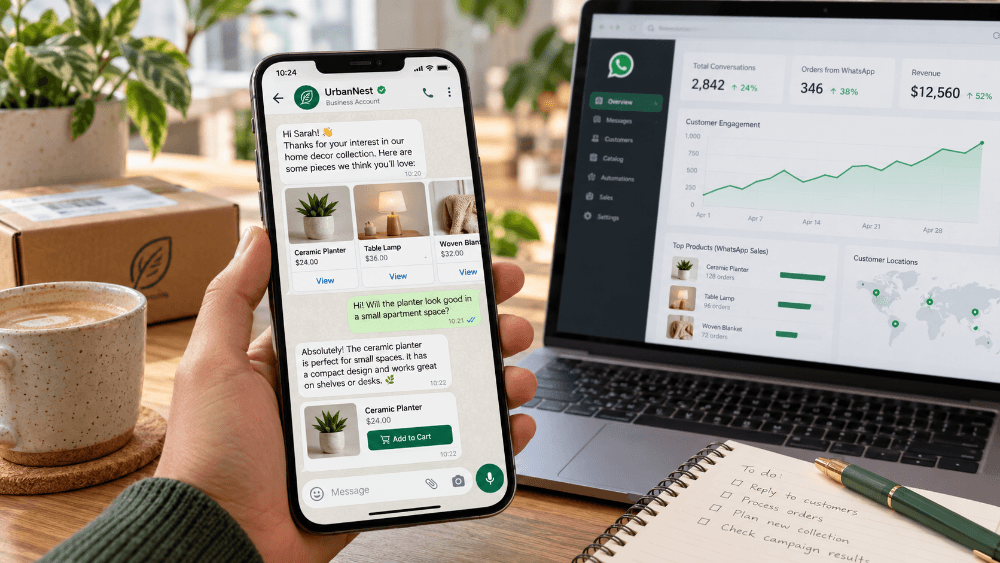
Unlike SMS, WhatsApp offers a familiar conversational interface that supports rich media, interactive responses, product discovery, customer service, and automated conversations.
The platform’s commercial momentum is also growing rapidly. By late 2025, paid WhatsApp messaging had reached a multibillion-dollar annual run rate, while click-to-message advertising continued expanding.
As a result, businesses increasingly use WhatsApp across multiple stages of the customer journey.
| Use Case | WhatsApp Business Opportunity |
|---|---|
| Lead generation | Start conversations from ads |
| Product discovery | Share recommendations and catalogs |
| Customer service | Resolve questions through chat |
| Appointments | Schedule and confirm bookings |
| Transactions | Send order and account updates |
| Retention | Deliver relevant follow-up messages |
However, WhatsApp does not offer the same universal reach as SMS. Customers need the application and an active WhatsApp account.
Therefore, businesses should treat WhatsApp as part of an omnichannel strategy rather than a universal replacement for SMS.
5. AI Agents Will Transform A2P Messaging
Artificial intelligence may create the largest change in how businesses manage messaging in 2027.
Traditional messaging automation follows predefined rules. For example, a customer enters a keyword, and the system returns a fixed response.
AI agents can interpret natural language, retrieve customer information, make decisions, and continue conversations dynamically.
For example, a customer might text:
“My package hasn’t arrived. Can you check where it is?”
An AI agent connected to order and shipping systems could identify the customer, retrieve tracking information, explain the delay, and offer the next available action.
Moreover, Businesses Can Use AI Agents For:
- Product recommendations
- Lead qualification
- Appointment scheduling
- Order questions
- Basic troubleshooting
- Customer-service routing
- Personalized promotions
By mid-2026, more than one million businesses were already using Meta Business Agent across WhatsApp and Messenger.
As a result, conversational AI will likely become a standard layer within A2P messaging platforms.
6. Omnichannel Messaging Will Replace Channel-First Thinking
Businesses historically chose a channel first and built campaigns around it.
That approach is changing.
Instead, messaging systems increasingly choose channels based on customer preference, message urgency, cost, and availability.
For Example, a Business Might Attempt:
- RCS for an interactive promotion.
- WhatsApp for customers who prefer that platform.
- SMS when richer channels remain unavailable.
This model allows businesses to maximize both engagement and reach.
Furthermore, recent messaging-platform data shows that companies increasingly operate across four, five, or even six communication channels rather than relying on one or two.
Therefore, in 2027, businesses will increasingly design customer journeys first and select the channel second.
7. Personalization Will Become More Contextual
A2P personalization is also moving beyond first names and broad customer segments.
AI and real-time customer data let businesses personalize communication based on current behavior.
For example, a customer who recently purchased a product shouldn’t keep receiving abandoned-cart reminders for the same item.
Instead, the messaging system could automatically move that person into a post-purchase journey.
Likewise, a high-value customer might receive early access to a product launch, while someone with an unresolved support issue receives no promotional messages.
Consequently, personalization will increasingly depend on customer context rather than static profile data.
8. Security, Trust and Sender Verification Will Matter More
As business messaging grows, fraud and unwanted traffic remain major concerns.
Spam, phishing, spoofed sender identities, and artificially inflated traffic can damage consumer trust while increasing costs for businesses and carriers.
As a result, verified identities will become increasingly important.
RCS can display authenticated brand profiles, while WhatsApp uses verified business identities and platform controls. Meanwhile, SMS ecosystems continue strengthening registration and carrier-level enforcement through systems such as A2P 10DLC in the United States.
Businesses Should Therefore Expect Stronger Requirements Around:
- Sender verification
- Consent records
- Campaign registration
- Traffic monitoring
- Opt-out handling
- Fraud prevention
- Message quality
Trust will increasingly become part of messaging infrastructure rather than merely a marketing concern.
9. Messaging Analytics Will Measure Conversations, Not Just Sends
Traditional A2P reporting often focuses on delivery rates, message volume, clicks, and conversions.
However, conversational channels require a broader set of metrics.
Businesses should increasingly track:
- Conversation-start rate
- Response rate
- Resolution rate
- Messages per conversation
- Human escalation rate
- Cost per resolved conversation
- Revenue per conversation
- Customer satisfaction
- Incremental conversion lift
Businesses will also need to compare performance across channels.
For example, RCS may cost more than a basic SMS message but produce higher conversion because customers can browse products directly inside the conversation.
Therefore, cost per message alone will become a less useful measure of channel performance.
What Should Businesses Prepare for in 2027?
Businesses do not need to abandon SMS or migrate every campaign to a new platform.
Instead, they should build flexible messaging infrastructure.
Start with reliable SMS coverage and strong consent management. Then, add RCS where richer interactions improve the customer journey and WhatsApp where customer adoption justifies it.
Moreover, connect messaging platforms with CRM, ecommerce, support, and customer-data systems. That foundation allows AI agents and automation to make better decisions.
Finally, measure customer outcomes, not messaging volume.
The future of A2P messaging will not belong to SMS, RCS, or WhatsApp alone.
Instead, successful businesses will combine them.
SMS will provide universal reach, RCS will add native rich interactions, WhatsApp will enable conversational commerce, and AI will help businesses decide when and how to use each channel.
Ultimately, A2P messaging in 2027 will become less about sending messages and more about managing intelligent customer conversations across whichever channel works best.