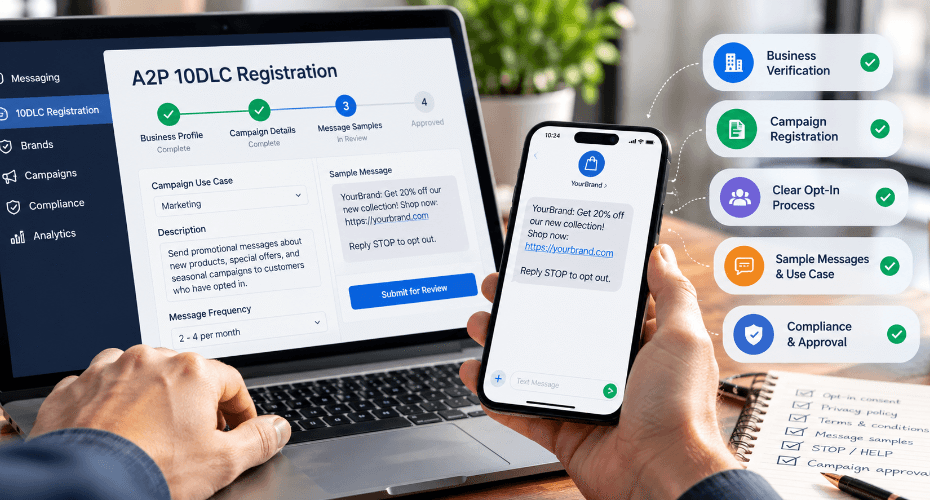
Businesses that send application-generated SMS or MMS messages to U.S. customers through standard 10-digit phone numbers need to understand A2P 10DLC. What once looked like a simple phone-number setup has become a structured registration process involving business identity, campaign purpose, customer consent, sample messages, privacy policies, and terms.
Moreover, registration requirements have become more detailed. Messaging providers and campaign reviewers increasingly examine whether the business website, opt-in experience, privacy disclosures, and actual messaging use case match the information submitted during registration.
Therefore, companies planning business texting in 2027 should treat 10DLC registration as part of their messaging strategy rather than an administrative task completed at the last minute.
What Is A2P 10DLC?
A2P stands for Application-to-Person messaging, while 10DLC means 10-digit long code. Together, A2P 10DLC describes business messaging sent through software using ordinary-looking U.S. local phone numbers.
For example, a company might use 10DLC for:
- Promotional SMS campaigns
- Appointment reminders
- Order notifications
- Customer support
- Delivery alerts
- Account updates
- Lead follow-ups
- Two-factor authentication
- Service notifications
The system allows carriers to understand who sends messages and why.
Instead of allowing unidentified high-volume traffic to move through consumer-style routes, businesses register their identity and messaging use case. As a result, carriers gain greater visibility, while legitimate businesses gain access to approved A2P messaging routes.
Brand Registration Comes First
A typical 10DLC onboarding process starts with registering the business.
Businesses generally need information such as:
- Legal company name
- Business type
- Employer Identification Number or tax ID
- Business address
- Website
- Industry
- Contact information
The registration details should match official business records.
For instance, submitting a trading name that differs significantly from the legal entity connected to the tax ID may cause verification problems. Therefore, companies should confirm their official information before beginning registration.
Likewise, the website should look legitimate and clearly relate to the registered business. Providers may examine public-facing websites as part of campaign vetting, so unfinished, inaccessible, or unrelated websites can create additional friction.
Campaign Registration Explains How You Will Text Customers
After registering the business, companies typically register individual messaging campaigns.
A campaign tells carriers and reviewers what types of texts the company plans to send.
For example, a campaign description might explain that an e-commerce store sends promotional messages about seasonal offers and product launches to customers who explicitly subscribed through its website.
A strong campaign registration usually includes:
| Registration Element | What It Should Explain |
|---|---|
| Campaign description | Who sends messages, to whom, and why |
| Use case | Marketing, customer care, OTP, notifications, etc. |
| Sample messages | Realistic examples of messages customers receive |
| Message flow | Exactly how customers opt in |
| Opt-out process | How customers can stop messages |
| HELP response | How customers receive support information |
| Privacy policy | How phone number and customer data are handled |
| Terms | Program details and messaging conditions |
Therefore, vague descriptions such as “We send messages to customers” often provide too little information.
A detailed explanation helps reviewers understand the real communication flow.
The Opt-In Process Is One of the Most Important Parts
Consent has become a major focus of 10DLC campaign review.
Businesses must explain how subscribers provide permission before receiving messages. Furthermore, the opt-in process described during registration should actually exist.
For example, an online opt-in might work like this:
- A customer visits the company’s website.
- The customer enters a mobile phone number.
- A clear disclosure explains the SMS program.
- The customer selects an unchecked consent box.
- The company records the consent.
Twilio’s current registration guidance states that campaign message-flow descriptions must explain how users opt in, and the registration should list all opt-in methods the campaign uses. When websites handle consent, reviewers may inspect the relevant forms and policy pages.
Therefore, businesses should avoid describing an idealized opt-in process that differs from the live customer experience.
Your Website Opt-In Needs Clear Disclosures
A form that asks only for a phone number usually doesn’t explain enough about a recurring marketing program.
Instead, businesses should clearly communicate what subscribers should expect.
Depending on the campaign, a strong disclosure may include:
- Business or program name
- Message purpose
- Recurring-message disclosure
- Expected message frequency
- “Message and data rates may apply”
- STOP instructions
- HELP information
- Links to privacy policy and terms
Moreover, marketing consent should generally remain separate from unrelated actions.
For example, a business should avoid forcing customers to accept promotional texts simply to create an account when marketing consent is not necessary for that service.
Privacy Policies and Terms Are Now Central to Registration
Privacy and terms pages have become increasingly important in A2P 10DLC registration.
Beginning June 30, 2026, Twilio started requiring valid, publicly accessible Privacy Policy and Terms & Conditions URLs for new A2P 10DLC campaign registrations submitted through its Messaging REST API. Campaign submissions missing those fields can fail review.
Therefore, businesses entering 2027 should assume that dedicated policy documentation forms part of standard registration preparation.
A messaging privacy policy should clearly explain how the business collects and uses customer information. Additionally, current provider guidance emphasizes language stating that the business will not sell or share SMS opt-in information with third parties for their own marketing purposes.
Terms should also describe the messaging program itself, including frequency, support details, STOP instructions, and applicable message-and-data-rate disclosures.
Sample Messages Must Match the Campaign
Registration typically requires sample messages.
These examples help reviewers understand what customers will actually receive.
For example:
“ABC Shoes: Our weekend sale starts Friday. Save 20% on selected styles: [link]. Reply STOP to opt out.”
The sample identifies the sender, matches a promotional campaign, includes a plausible call to action, and provides an opt-out path.
Conversely, a campaign registered for customer-service notifications should not include samples that resemble aggressive sales promotions.
Moreover, any website links included in the messages should relate to the registered business. Providers may scrutinize links because malicious messaging frequently relies on misleading or suspicious URLs.
Therefore, the campaign description, use case, website, opt-in, and sample messages should tell one consistent story.
Why 10DLC Registrations Get Rejected
Many registration problems come from inconsistencies rather than complicated technical issues.
Common reasons may include:
- Incomplete opt-in descriptions
- Missing SMS disclosure language
- Preselected consent checkboxes
- Unclear campaign purposes
- Unrelated sample messages
- Broken or inaccessible websites
- Privacy policies missing SMS-specific language
- Missing terms and conditions
- Business details that cannot be verified
- URLs unrelated to the registered company
As a result, businesses should review the entire customer journey before submitting a campaign.
Imagine a company claims that customers subscribe at example.com/sms, but that page contains no visible SMS consent disclosure. Reviewers may question whether the business actually collects valid permission.
Fixing the customer experience before registration often saves more time than repeatedly resubmitting rejected campaigns.
10DLC Registration Does Not Replace Legal Consent
One of the most important distinctions is between registration and compliance.
Receiving campaign approval does not automatically mean every message the company sends complies with the TCPA, FCC rules, state laws, or other applicable requirements.
Likewise, registering a campaign does not give the business permission to text arbitrary phone numbers.
10DLC primarily identifies the business and approved messaging use case within the carrier ecosystem. Customer consent remains a separate responsibility.
Therefore, Businesses Should Maintain Their Own Consent Records, Including:
- Subscriber phone number
- Date and time of consent
- Signup method
- Disclosure shown
- Campaign or program joined
- Source URL or form
- Opt-out date when applicable
Detailed records become especially valuable if a subscriber disputes whether they opted in.
Keep Campaign Information Updated
Businesses also need to consider what happens after approval.
Messaging programs change over time. A company may add new products, redesign a website, change its opt-in form, or introduce different messaging purposes.
However, major changes can create a mismatch between the registered campaign and the traffic it receives.
For example, a campaign registered for appointment reminders should not gradually turn into a daily promotional channel.
Therefore, companies should periodically review registrations and confirm that the approved campaign still reflects the real messaging program.
A Practical 10DLC Checklist for 2027
Before submitting a new campaign, confirm that:
- Legal business information matches official records.
- The company website is public and functional.
- The campaign description explains who, what, and why.
- Sample messages accurately represent real traffic.
- The opt-in flow clearly collects consent.
- Consent checkboxes are not preselected.
- Privacy and terms pages include SMS-specific information.
- STOP and HELP processes work correctly.
- Website links match the registered business.
- You can retrieve consent records when needed.
Businesses should also register well before an important launch. Campaign review can take time, particularly when reviewers request changes or additional evidence.

10DLC Registration Is Becoming Part of Messaging Operations By 2027
A2P 10DLC registration should no longer surprise businesses using SMS at scale.
The process reflects a broader shift toward verified business messaging, documented consent, transparent customer communication, and stronger carrier oversight.
Therefore, companies should build registration requirements into their SMS launch process from the beginning.
Start with accurate business information. Then, create a clear opt-in experience, publish appropriate privacy and terms pages, prepare realistic sample messages, and document the exact use case.
Ultimately, successful 10DLC registration depends on consistency. The business identity, campaign description, website, opt-in flow, policies, and live messages should all describe the same program.
When they do, companies can reduce registration friction and build a stronger foundation for compliant, trustworthy business texting in 2027.