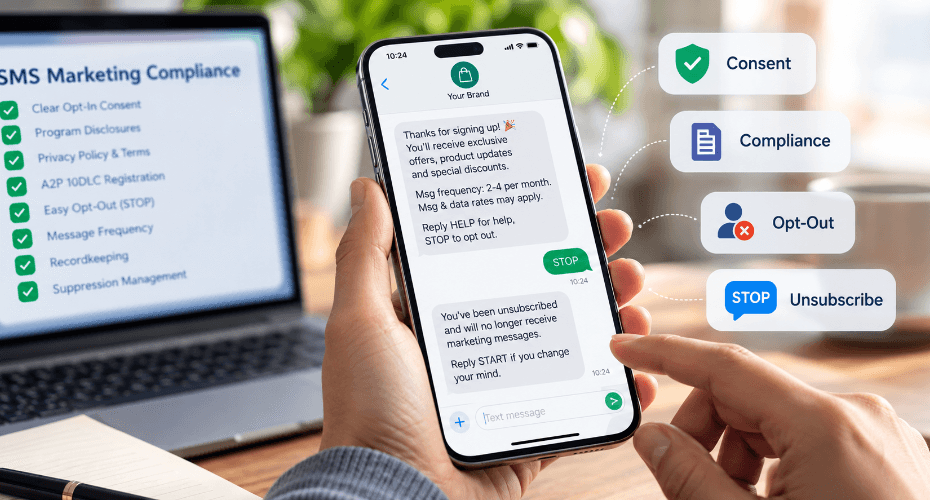
SMS marketing remains one of the most direct ways for businesses to reach customers. However, that direct access also comes with strict expectations around consent, transparency, opt-outs, and responsible use of customer phone numbers.
By 2027, businesses should expect SMS compliance to go beyond simply adding “Reply STOP to unsubscribe” to promotional messages. Federal rules, carrier requirements, CTIA best practices, A2P 10DLC registration standards, and messaging-provider policies increasingly require businesses to document how customers opt in and how quickly opt-out requests move through connected systems.
Therefore, SMS compliance should become part of the customer journey itself. Businesses need clear permission before marketing, accurate records afterward, and reliable suppression systems when subscribers decide to leave.
What Does SMS Marketing Compliance Mean?
SMS compliance refers to the legal, carrier, and industry requirements businesses must follow when sending text messages to consumers.
In the United States, several layers may apply. The Telephone Consumer Protection Act, FCC regulations, CTIA messaging guidance, carrier policies, and A2P 10DLC requirements can all affect business texting.
Although these frameworks differ, they share several core principles:
- Obtain appropriate consent before messaging
- Explain what customers are signing up for
- Keep records of that consent
- Identify the business or program clearly
- Respect message-frequency expectations
- Provide an easy way to opt out
- Stop covered messages after consent gets revoked
CTIA continues to emphasize two fundamental expectations for non-consumer senders: obtain consent before texting and provide consumers with a way to stop additional messages.
Consequently, a compliant SMS strategy starts before the first message ever reaches the customer.
Consent Remains the Foundation of SMS Marketing
A phone number alone does not automatically give a business permission to send promotional texts.
For example, a customer may provide a mobile number for delivery notifications, account security, or appointment coordination. That does not necessarily mean the customer has agreed to receive recurring marketing offers.
Therefore, businesses should clearly separate different messaging purposes.
What Should an SMS Opt-In Explain?
A strong marketing opt-in should make the program easy to understand before the customer provides consent.
Depending on the program and applicable requirements, the disclosure commonly includes:
- The brand or program name
- The type of messages subscribers will receive
- Whether messages recur
- Expected message frequency
- A message-and-data-rates disclosure
- Instructions for getting help
- Instructions for opting out
- Links to applicable terms and privacy information
Moreover, the actual campaign should match the promise made during signup.
For example, if someone consents to receive appointment reminders, suddenly sending unrelated weekly promotions creates both compliance and customer-experience risks.
A2P 10DLC Makes the Opt-In Process More Visible
Businesses that use standard U.S. 10-digit numbers for application-generated messaging often operate within the A2P 10DLC ecosystem.
Campaign registration asks businesses to describe not only what they send but also exactly how customers consent.
Twilio’s current A2P 10DLC documentation, reflecting Campaign Registry requirements, asks registrants to provide a detailed message flow explaining how end users opt in. If a website handles signup, reviewers may also inspect the live opt-in experience, terms, and privacy policy.
Therefore, the registration information and the real customer journey must align.
A business should not register a campaign by claiming that customers check a dedicated SMS consent box while its live website simply collects phone numbers without any messaging disclosure.
Such inconsistencies may create registration problems and increase compliance risk.
Privacy Policies and Terms Matter More in 2027
Messaging providers have also increased scrutiny around privacy and program terms.
For example, Twilio began requiring new A2P 10DLC campaign registrations submitted through its API after June 30, 2026, to include valid, publicly accessible privacy-policy and terms-and-conditions URLs. Campaign submissions that omit them can be rejected.
Moreover, current onboarding guidance expects privacy policies to address mobile-number handling and expects messaging terms to explain the program, message frequency, support information, and opt-out process.
Consequently, businesses preparing for 2027 should treat these pages as operational documents rather than generic website boilerplate.
Their privacy policy, terms, signup form, campaign registration, and actual messages should all describe the same program.
Opt-Outs Are No Longer Just About the Word STOP
STOP remains one of the most important SMS opt-out keywords. However, businesses should not design systems that only recognize one exact command.
The FCC has clarified that consumers can revoke consent through reasonable methods that clearly express a desire to stop covered robocalls or robotexts. Its rules specifically recognize standard reply words and also protect reasonable revocation methods more broadly.
Therefore, Businesses Should Prepare for Requests Such As:
- STOP
- QUIT
- END
- REVOKE
- OPT OUT
- CANCEL
- UNSUBSCRIBE
- Please stop texting me
- Remove me from your list
The exact technical handling may depend on the platform and messaging type. Nevertheless, the practical principle remains straightforward: when a customer clearly asks to stop receiving marketing texts, the business should not force them through an unnecessarily complicated process.
Businesses Need Centralized Suppression Systems
Opt-outs get complicated when multiple departments or software platforms communicate with the same customer.
For example, one company may operate:
- Marketing automation software
- A sales CRM
- Customer-service texting
- Appointment reminders
- E-commerce notifications
- An AI messaging agent
If a customer opts out through one system, disconnected databases can create problems.
Therefore, businesses should synchronize suppression information across relevant systems.
A customer should not text “STOP” to a marketing number and then continue receiving the same promotional campaign through another workflow simply because the second platform has not updated yet.
Centralized consent and suppression records will become increasingly important as businesses add AI agents and omnichannel messaging.
How Quickly Must Businesses Process Opt-Out Requests?
FCC rules require covered callers and texters to honor certain do-not-call and consent-revocation requests within a reasonable period that cannot exceed 10 business days.
However, businesses should not interpret 10 business days as a recommended waiting period.
Modern messaging systems can often suppress promotional texts almost immediately. Faster processing reduces the risk of sending unwanted messages and improves the customer experience.
A strong operational goal is simple: once a valid opt-out enters the system, stop applicable messages as quickly as technically practical.
Companies should also regularly test their STOP workflows. A suppression system that works during setup can later break because of integrations, migrations, routing changes, or CRM updates.
Consent Revocation Rules Continue to Evolve
Businesses planning for 2027 should also understand that FCC consent-revocation rules have changed in practice.
The FCC strengthened rules on reasonable methods for revoking consent and set a maximum 10-business-day processing timeframe. However, the Commission delayed part of the broader revocation framework that would require a revocation made in response to one category of communication to apply across unrelated robocalls or robotexts from the same sender.
Therefore, companies should avoid oversimplifying the rule into “one STOP always cancels absolutely everything.”
Different message categories, exemptions, consent requirements, and the customer’s expressed intent may matter.
This complexity makes centralized consent architecture and qualified legal review increasingly valuable for businesses operating several messaging programs.
Double Opt-In Can Strengthen Consent Records
Double opt-in isn’t required for every SMS marketing program. However, it can provide additional protection in higher-risk situations.
A typical double opt-in works like this:
- Customer enters a phone number.
- The signup page displays clear SMS disclosures.
- The business sends a confirmation message.
- The customer replies YES or takes another confirmation action.
- The business records the confirmed subscription.
This process can reduce accidental signups and situations where someone enters another person’s number.
Moreover, businesses can preserve stronger evidence of customer intent.
Therefore, companies should consider double opt-in for lead-generation forms, shared devices, higher-risk acquisition sources, or programs where proving consent may become particularly important.
Keep Detailed Consent Records
A compliant SMS program needs more than a list of phone numbers.
Businesses should preserve information showing how and when subscribers joined.
Useful consent records may include:
| Record | Why It Matters |
|---|---|
| Phone number | Identifies the subscribed contact |
| Date and time | Shows when consent occurred |
| Signup source | Identifies the form, keyword, or workflow |
| Disclosure shown | Demonstrates what the subscriber agreed to |
| Consent type | Separates marketing from transactional permissions |
| Terms version | Shows which conditions applied |
| Opt-out timestamp | Records when consent ended |
Businesses should also preserve changes to their consent language.
If a signup page changes six months later, the company should still be able to determine what an older subscriber originally saw.
AI Agents Need Compliance Guardrails Too
AI is increasingly used in business texting, but artificial intelligence doesn’t create new permission.
An AI agent should never decide on its own that a support customer should start receiving promotional texts.
Likewise, AI systems should recognize natural-language opt-outs instead of relying only on predefined keywords.
Therefore, companies should place consent controls outside the AI’s discretionary decision-making wherever possible.
For example, the messaging infrastructure should automatically block a promotional send when a contact appears on a suppression list, even if an AI agent decides the customer is likely to purchase.
Compliance rules should outrank optimization rules.
A Practical SMS Compliance Checklist for 2027
Before sending marketing texts, businesses should confirm that:
- Customers provided appropriate consent.
- Signup disclosures clearly describe the SMS program.
- Consent records include the source and timestamp.
- A2P 10DLC registration matches the actual use case.
- Privacy policy and terms URLs remain current.
- Marketing and transactional permissions stay properly separated.
- STOP and other reasonable opt-out requests work.
- Suppression data synchronizes across relevant platforms.
- AI agents cannot override consent rules.
- Teams periodically audit the entire messaging journey.

SMS Compliance Is Ultimately About Customer Control
SMS regulations, carrier requirements, and registration procedures will continue evolving in 2027. However, the underlying principle remains remarkably consistent.
Customers should understand what they are agreeing to, receive the messages they requested, and have an easy way to stop them.
Businesses that design around those principles gain more than regulatory protection. They also build healthier subscriber lists and stronger customer trust.
Therefore, SMS compliance should not function as a legal layer added after a campaign launches.
It should shape the entire messaging program—from the first checkbox to the final opt-out.
When consent is clear, records are accurate, suppression happens quickly, and messages match customer expectations, businesses can use SMS effectively without sacrificing the trust that makes the channel valuable in the first place.