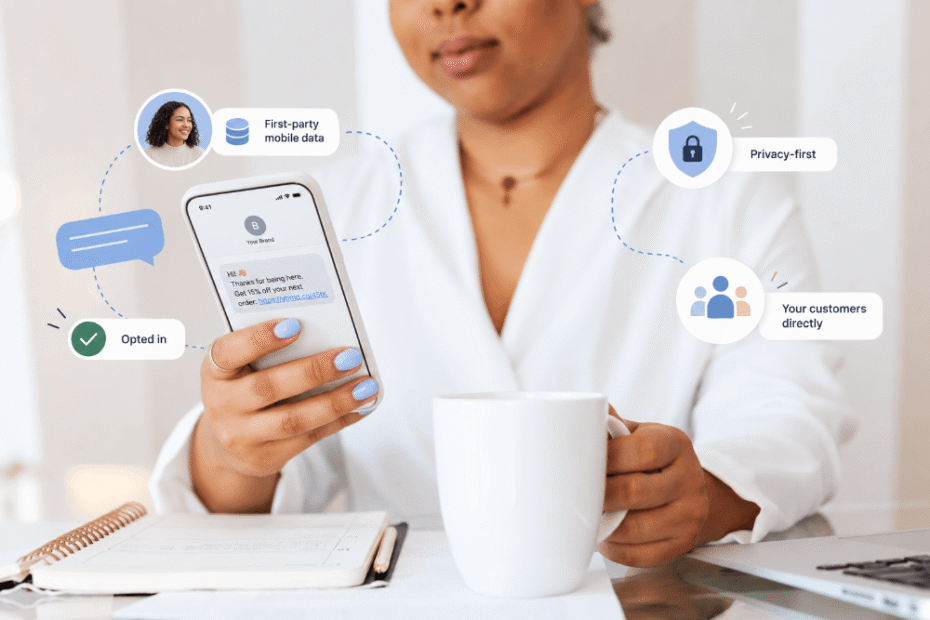
Digital marketing has long relied heavily on third-party tracking. Advertisers used cross-site identifiers, advertising platforms, and third-party cookies to understand customer interests, build audiences, and retarget shoppers across the web.
However, privacy regulations, browser restrictions, mobile privacy controls, and changing consumer expectations have made third-party tracking less dependable. As a result, marketers increasingly need information collected through relationships they own.
That shift gives SMS marketing a significant advantage.
When customers voluntarily provide their mobile numbers, respond to messages, click links, complete purchases, or share preferences, businesses create first-party data that can support personalization without relying heavily on outside tracking networks.
Therefore, the future of SMS marketing will depend increasingly on how effectively brands collect, connect, and use first-party mobile data.
What Is First-Party Mobile Data?
First-party data is information a business collects directly through its own interactions with customers.
In SMS marketing, that information starts with the customer’s mobile number and consent status. However, it can become much richer as the relationship develops.
First-party mobile data may include:
- SMS subscription status
- Signup source
- Link clicks
- Message replies
- Purchases
- Cart activity
- Product preferences
- Loyalty status
- Appointment history
- Customer-service conversations
- Survey responses
- Message engagement
- Opt-out behavior
For example, a customer might join an SMS list after viewing running shoes, purchase a pair two days later, and then respond to a post-purchase message about preferred sports.
Together, those interactions create a useful customer profile based on a direct relationship rather than anonymous cross-site tracking.
Why Third-Party Tracking Is Becoming Less Reliable
Third-party tracking has not disappeared completely. However, marketers face increasing restrictions on how they can identify and follow users across websites and devices.
Browsers have tightened tracking controls, consumers have gained more privacy options, and regulations have increased expectations around transparency and data use.
As a result, businesses cannot build long-term marketing strategies on the assumption that external identifiers will always remain available.
Additionally, third-party data often creates another problem: it distances the business from the customer.
A purchased audience segment might suggest someone is interested in fitness. Meanwhile, the business’s own data may show that the same customer bought running shoes twice, clicked three marathon-related messages, and explicitly selected “long-distance running” as an interest.
The second dataset usually provides far more useful context.
Therefore, first-party data improves both privacy resilience and marketing relevance.
Why SMS Is Naturally Suited to First-Party Data
SMS creates a direct relationship between a business and a known subscriber.
Unlike anonymous advertising audiences, an SMS subscriber has intentionally provided a phone number and, for marketing programs, appropriate consent to receive messages.
That makes mobile numbers powerful identifiers for customers.
Moreover, every subsequent interaction can add additional context.
For Example:
- A subscriber joins through a product page.
- They click an SMS promoting a specific category.
- They make a purchase.
- They later reply with a question about a product.
- They join the loyalty program.
- They purchase again three months later.
Each interaction helps the business better understand the customer.
Therefore, SMS can function as both a communication channel and a source of valuable first-party behavioral data.
First-Party Data Makes SMS Segmentation Smarter
Basic SMS segmentation may divide subscribers by location, age, or purchase history.
However, first-party behavioral data enables much more useful groups.
For example, a retailer could create segments for:
- New subscribers who have never purchased
- Customers who purchased within 30 days
- High-value repeat buyers
- Customers interested in a specific category
- Subscribers who regularly click SMS links
- Customers likely to need replenishment
- Previously active customers who stopped purchasing
As a result, marketers no longer need to send the same promotion to the entire database.
A new subscriber might receive an introductory message, while a loyal customer receives early access to a product launch.
Meanwhile, you can exclude customers who recently purchased from an unnecessary discount campaign.
That suppression can matter just as much as personalization.
SMS Personalization Goes Beyond First Names
First-party data also changes what personalization means.
Adding “Hi Sarah” to a promotional text provides limited value if the rest of the message has nothing to do with Sarah’s interests.
Instead, marketers can use customer actions to personalize the message itself.
| First-Party Signal Possible SMS Personalization | |
|---|---|
| Product viewed | Product reminder |
| Recent purchase | Complementary recommendation |
| Repeated purchase | Replenishment reminder |
| Loyalty status | VIP access or reward |
| Abandoned cart | Relevant cart reminder |
| Preferred category | Targeted product launch |
| Store location | Local promotion or event |
| SMS engagement | Adjusted frequency |
For example, a customer who regularly buys coffee every six weeks could receive a replenishment reminder near the expected reorder date.
Personalization matters because it responds to customer behavior rather than simply inserting profile information into generic messages.
Zero-Party Data Makes the Strategy Even Stronger
First-party data records what customers do. Meanwhile, zero-party data captures what customers deliberately tell a business about themselves.
Both can work together.
Brands can collect zero-party data through:
- SMS surveys
- Preference centers
- Quizzes
- Keyword replies
- Signup questions
- Post-purchase feedback
- Two-way conversations
For example, a clothing retailer might ask:
“What do you want to hear about? Reply 1 for menswear, 2 for womenswear, or 3 for accessories.”
The answers can immediately improve segmentation.
Moreover, asking customers directly can sometimes provide better information than inferring their preferences through behavioral tracking.
Behavioral Automation Becomes More Powerful
First-party data becomes especially valuable when businesses connect it to automated SMS journeys.
Instead of manually selecting customers for every campaign, businesses can trigger messages when relevant events occur.
For instance:
- Browse abandonment: A customer repeatedly views an item but does not purchase.
- Cart abandonment: A customer leaves products in their cart.
- Back in stock: A previously unavailable product becomes available.
- Post-purchase: A customer receives useful product information after ordering.
- Replenishment: Purchase history suggests that the customer may need to reorder.
- Win-back: A previously active customer stops buying for an extended period.
These messages often perform better because they reflect an identifiable customer action.
Furthermore, automation can react quickly. The business does not need to wait for a marketer to manually review customer behavior.
First-Party Data Improves AI SMS Marketing
Artificial intelligence makes first-party data even more valuable.
AI can analyze customer behavior to identify patterns that manual segmentation may miss. For example, a model might estimate purchase likelihood, churn risk, preferred send time, product interest, or expected lifetime value.
However, AI is only useful when the underlying data stays accurate.
Poor data can lead to poor decisions.
For instance, an AI system may keep recommending a product after the customer has already purchased it if purchase information doesn’t update across platforms.
Therefore, businesses should connect their SMS platform with ecommerce systems, CRM software, loyalty programs, customer support, and other relevant first-party sources.
Better connections create better context.
First-Party Data Can Improve Attribution
Marketing attribution gets harder as third-party tracking weakens.
SMS provides several direct signals that can help businesses understand performance.
Marketers can track:
- SMS link clicks
- Coupon-code usage
- Purchases after engagement
- Revenue per recipient
- Responses
- Conversions from automated flows
- Repeat purchases
- Customer lifetime value
However, marketers should avoid assuming every purchase after an SMS happened because of that text.
For example, a customer might receive an SMS, later see an Instagram advertisement, and then purchase through a direct website visit.
Therefore, businesses should combine platform attribution with holdout testing, incrementality analysis, and, where appropriate, shorter attribution windows.
The goal should be to measure additional business value, not simply claim as much revenue as possible.
Consent Makes First-Party Mobile Data Valuable
First-party data does not remove privacy responsibilities.
A customer sharing a phone number for delivery updates does not necessarily mean that the business can add that number to recurring marketing campaigns.
Therefore, businesses should collect clear SMS consent and maintain accurate records of what the customer agreed to receive.
CTIA messaging guidance emphasizes two basic principles: obtain consent before business messaging and give customers a clear way to opt out.
Businesses should also honor customer choices throughout the relationship.
Useful data loses its value when customers no longer trust how a company uses it.
How to Build a First-Party SMS Data Strategy
Businesses do not need to collect every possible data point.
Instead, start with information that directly improves the customer experience.
A practical strategy includes:
- Collect clear SMS consent.
- Record where each subscriber joined.
- Connect SMS engagement with customer profiles.
- Integrate purchase and website activity.
- Ask customers directly about useful preferences.
- Create behavior-based segments.
- Build triggered SMS journeys.
- Synchronize opt-outs across systems.
- Test personalization against simpler alternatives.
- Measure incremental revenue and retention.
Most importantly, avoid collecting information just because the technology allows it.
Every data point should support a legitimate customer or business purpose.
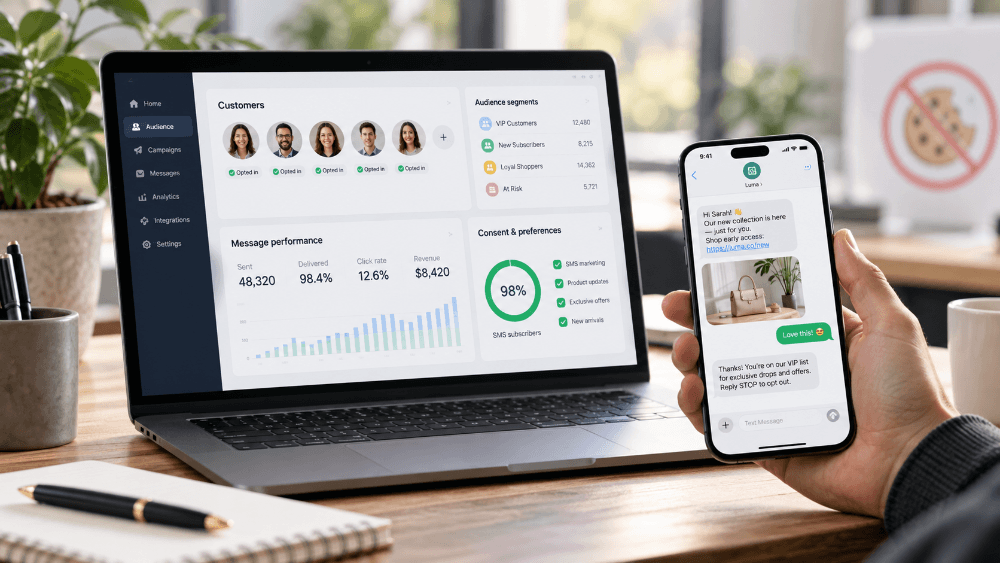
SMS Becomes More Valuable in a Privacy-First World
The decline in reliable third-party tracking does not mean marketers lose the ability to personalize communication.
Instead, it increases the value of direct customer relationships.
SMS sits naturally inside that shift because subscribers identify themselves, choose to receive messages, and continually generate useful engagement signals.
However, phone numbers alone do not create a strong first-party data strategy.
Businesses need connected customer profiles, clear consent, useful segmentation, behavioral automation, and responsible personalization.
Ultimately, marketers will rely less on tracking anonymous users across the internet and focus more on understanding customers who have already chosen to build a relationship with the brand.
That shift can make SMS marketing more privacy-resilient, relevant, measurable, and valuable.