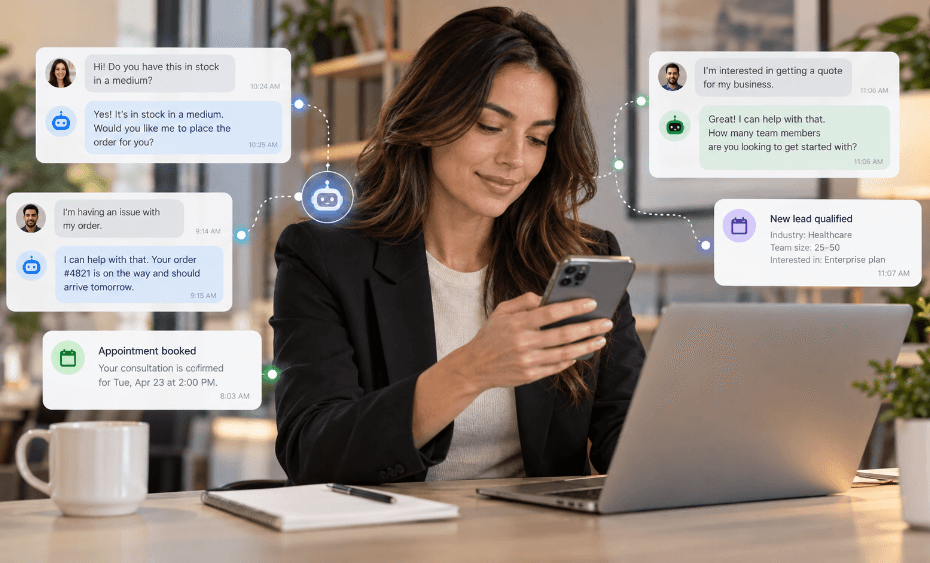
Business texting is evolving from simple notifications into real-time customer conversations. Instead of using SMS only for appointment reminders, promotions, and delivery updates, companies are increasingly using artificial intelligence to answer questions, qualify leads, recommend products, and guide customers through common tasks.
However, AI text messaging works best when businesses treat it as a customer-service system rather than a shortcut for sending more messages. The strongest AI agents combine automation with accurate customer data, clear business rules, and easy access to human support.
As a result, businesses can respond faster without forcing every conversation through a traditional call center.
What Is AI Text Messaging for Business?
AI text messaging uses artificial intelligence to understand incoming customer messages and determine an appropriate response or next action.
A basic SMS automation follows fixed instructions. For example, when a customer texts “HOURS,” the system returns store opening hours.
An AI agent can handle more flexible language.
A customer might write:
“Are you open after work tomorrow, and can I book an appointment?”
The AI can identify that the customer wants both opening hours and an appointment. Then, depending on its integrations and permissions, it can check availability, suggest times, confirm the booking, and update the business system.
As a result, AI agents can move beyond keyword-based autoresponders to more natural conversations.
What Can AI Agents Do Through Text Messaging?
Businesses can use AI agents across sales, support, scheduling, and customer retention. However, the best use cases involve repetitive conversations with clear answers or actions.
Answer Frequently Asked Questions
Customer-service teams often receive the same questions throughout the day.
For example, customers may ask about:
- Opening hours
- Shipping times
- Return policies
- Product availability
- Appointment requirements
- Pricing
- Order status
- Store locations
An AI agent can answer many of these questions instantly when it has access to approved business information.
Customers also don’t need to navigate a website, search an FAQ page, or wait on hold. Instead, they can ask a question in the same messaging channel they already use.
Qualify Leads Automatically
AI texting can also help sales teams identify which inquiries deserve immediate attention.
For example, a home-service company might receive the message:
“How much would it cost to replace my air conditioner?”
Instead of simply asking a salesperson to call, the AI agent could collect the property type, location, current system, preferred installation period, and contact information.
Then, it can classify the lead and route high-intent prospects to the sales team.
As a result, employees spend less time gathering basic information and more time helping qualified prospects.
Schedule and Manage Appointments
Appointment-based businesses can use AI agents to automate routine scheduling conversations.
For instance, an agent might:
- Ask what service the customer needs.
- Check available appointment times.
- Offer suitable options.
- Confirm the customer’s selection.
- Add the booking to the scheduling system.
- Send a reminder before the appointment.
The same conversation can also handle rescheduling or cancellations.
This approach can help salons, dental practices, automotive businesses, consultants, home-service companies, and other appointment-based organizations reduce administrative work.
AI Agents Can Personalize Customer Conversations
Traditional autoresponders often sound generic because every customer receives the same answer. AI becomes much more useful when businesses connect it with customer context.
For example, an existing customer asking “Where is my order?” shouldn’t have to provide every detail from the beginning.
If the system can safely identify the customer and access the appropriate order data, the agent may retrieve the latest status and answer directly.
AI Agents May Use Information Such As:
| Customer Context | How AI Can Use It |
|---|---|
| Previous purchases | Recommend related products |
| Active order | Provide status information |
| Loyalty status | Recognize benefits or rewards |
| Previous conversation | Continue without repeating questions |
| Product interest | Offer relevant information |
| Appointment history | Suggest suitable services |
Therefore, customer data can make the conversation faster and more relevant.
However, businesses should avoid unnecessary personalization. Customers may appreciate an agent remembering their order, but they may feel uncomfortable if a simple conversation suddenly reveals extensive behavioral tracking.
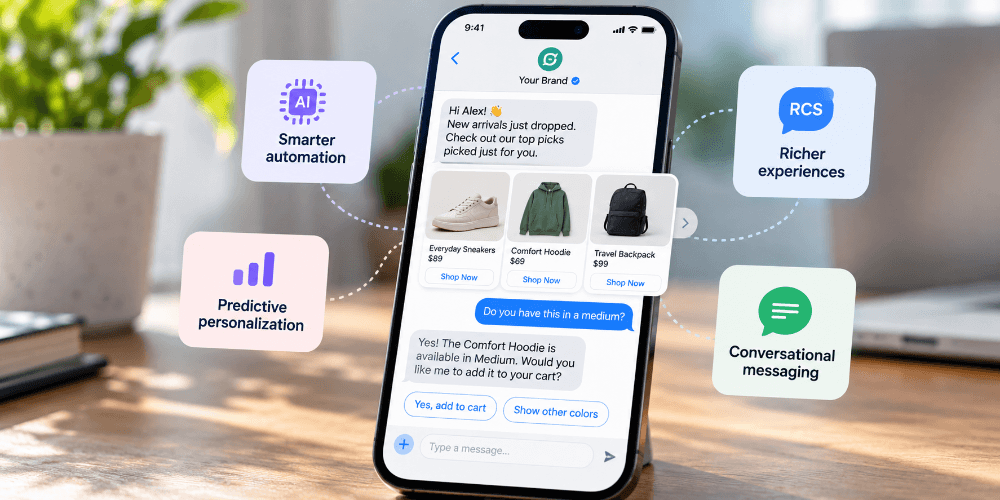
AI Can Support Conversational Commerce
AI text messaging also creates opportunities beyond traditional support.
Businesses can use conversations to help customers decide what to buy.
For example:
- Customer: “I need running shoes for long-distance training.”
- AI agent: “Do you prefer maximum cushioning or something lighter for faster runs?”
- Customer: “More cushioning.”
The agent can then retrieve appropriate products from the business catalog and provide relevant recommendations.
As a result, messaging becomes part of the shopping journey rather than just a promotional channel.
This approach works particularly well for products that generate questions about sizing, compatibility, availability, or selection.
Moreover, an AI agent can continue helping after the recommendation by sharing a checkout link or, when needed, transferring the customer to an employee.
Why Businesses Are Interested in AI Text Messaging
The biggest advantage is not simply lower staffing costs. Instead, AI helps businesses respond when customer demand exceeds available human capacity.
Faster Responses
Customers often text because they expect immediate responses.
AI agents can respond to common questions almost instantly, including outside normal business hours. As a result, companies can reduce wait times without staffing every conversation around the clock.
Better Scalability
A human employee can manage only a limited number of simultaneous conversations.
AI systems can handle many routine interactions at once. As a result, sudden campaign responses, product launches, seasonal demand, or service disruptions are easier to manage.
More Consistent Information
Employees may interpret policies differently or forget important details. In contrast, a properly configured AI system can retrieve information from approved sources and apply defined rules consistently.
However, businesses must keep those sources accurate. Otherwise, AI may consistently provide outdated information.
Where Human Support Still Matters
AI can handle many conversations, but it shouldn’t handle everything.
Some situations require judgment, empathy, negotiation, or authority that an automated system may not have.
For example, businesses should consider human escalation when customers report:
- Repeated service failures
- Complex billing disputes
- Serious complaints
- Unusual refund requests
- Sensitive personal circumstances
- Legal concerns
- High-value account problems
Additionally, customers should have an easy way to request a human.
Twilio’s recent conversational AI research found that many consumers value AI when it delivers faster resolutions, yet current experiences can still feel robotic. Therefore, successful AI messaging systems should combine automation with clear escalation rather than trying to remove people from the process entirely.
AI Text Messaging Still Requires Consent
Artificial intelligence does not change the underlying expectations around business texting.
CTIA guidance says non-consumer message senders should obtain consent before texting consumers and provide a clear way to opt out. Moreover, the organization’s live messaging should match the type of communication the customer agreed to receive.
Therefore, an AI agent should not automatically send promotional texts to a customer who requested a support message.
The system must also recognize opt-out requests.
Standard Commands May Include:
- STOP
- QUIT
- END
- CANCEL
- UNSUBSCRIBE
- OPT OUT
However, businesses should not rely solely on exact keywords. FCC rules also require covered senders to recognize other reasonable language that clearly communicates the customer’s desire to stop receiving messages.
As a result, phrases such as “Please stop texting me” should trigger the appropriate suppression process.
How to Deploy an AI Texting Agent Safely
Businesses should start with a narrow use case rather than giving an AI agent access to every workflow.
For example, begin with order-status questions or appointment scheduling. Then, monitor accuracy before expanding into sales recommendations or more complex support.
Also, set strict boundaries for what the agent can do.
A practical setup should include:
- Approved knowledge sources
- Clear access permissions
- Frequency limits
- Consent and opt-out protections
- Human escalation rules
- Conversation logging
- Regular quality reviews
- Testing before broader deployment
High-impact actions should also require additional safeguards. For example, an AI agent might explain a refund policy, while a human employee approves an unusual refund.
How Should Businesses Measure AI Text Messaging?
Response speed alone does not show whether an AI agent creates value.
Businesses should also measure:
- Resolution rate
- Human escalation rate
- Customer satisfaction
- Conversion rate
- Appointment bookings
- Qualified leads
- Average resolution time
- Repeat questions
- Opt-out rate
- Agent accuracy
Conversation reviews can also reveal issues that dashboards miss. For example, a high resolution rate may look impressive, even when customers still receive awkward or incomplete answers.
Therefore, businesses should combine quantitative metrics with regular conversation audits.
Should Businesses Use AI Agents for Customer Texting?
For many businesses, yes.
AI agents can handle routine questions, schedule appointments, qualify leads, personalize responses, and assist customers throughout the buying journey. They can also provide immediate support when human teams are unavailable.
However, the goal shouldn’t be to replace every employee with automation.
Instead, businesses should let AI handle predictable conversations while humans manage situations that require judgment, empathy, or flexibility.
Ultimately, effective AI text messaging feels less like a chatbot and more like efficient customer service. The technology handles simple tasks quickly, uses accurate information, respects customer consent, and knows when to bring a person into the conversation.