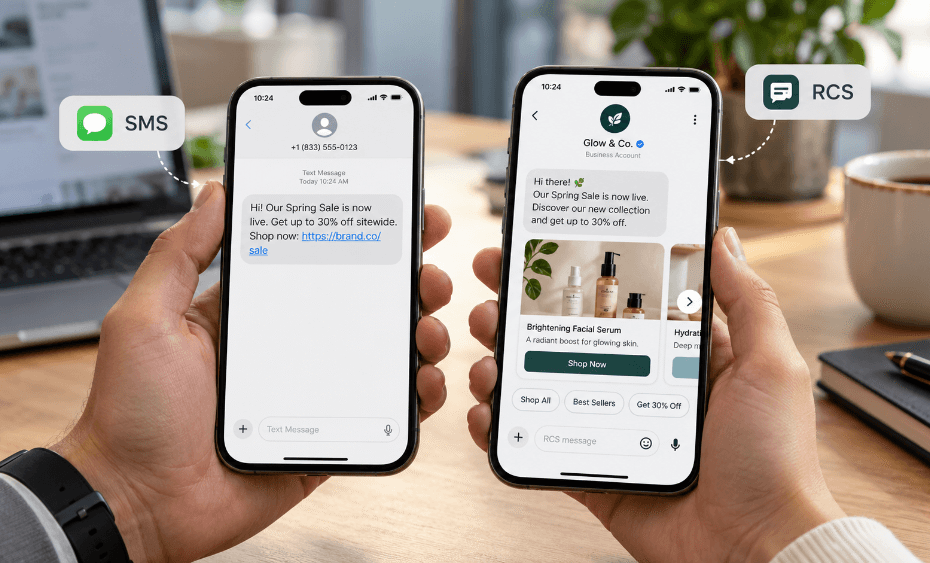
SMS has powered business messaging for decades, but Rich Communication Services, or RCS, is changing what brands can deliver inside a customer’s native messaging app.
Instead of plain text and links, RCS can support branded profiles, high-resolution images, videos, buttons, rich cards, suggested replies, and interactive product experiences. Meanwhile, SMS still offers something RCS cannot fully match: extremely broad device and carrier compatibility.
So the question isn’t simply whether RCS is better than SMS. Brands need to understand where each channel performs best and how to use them together.
For many businesses, the strongest strategy is to use RCS when supported and keep SMS as a reliable fallback.
What Is SMS Marketing?
SMS marketing uses Short Message Service to send text-based messages directly to customer phones.
Businesses commonly use SMS for:
- Promotional campaigns
- Appointment reminders
- Order confirmations
- Delivery notifications
- Abandoned-cart messages
- Security alerts
- Event reminders
- Two-way customer support
SMS messages typically include text and links, and longer messages may split into multiple segments. Most importantly, SMS works across a wide range of devices without requiring customers to download a specific messaging app.
As a result, SMS remains one of the simplest ways to reach customers directly.
Its limitations, however, are equally clear. SMS offers limited branding, no native product carousels, no interactive buttons, and no built-in read receipts. As a result, brands often need to send customers to a website to complete more complex actions.
What Is RCS Marketing?
RCS expands traditional mobile messaging into a richer, more interactive experience.
Instead of displaying only plain text, an RCS business message can include brand identity, multimedia content, interactive suggestions, and guided customer actions.
Google’s RCS for Business platform supports text, rich cards, media, PDFs, suggested replies, and suggested actions. As a result, brands can create customer journeys that feel closer to an app experience while remaining inside the default messaging environment.
Common RCS Capabilities Include:
- Verified business profiles
- Company logos and branding
- High-quality images and video
- Rich product cards
- Carousels
- Suggested replies
- Call-to-action buttons
- Read receipts
- Typing indicators
- Location and calendar actions
Therefore, RCS can do more than notify a customer. It can help them explore, choose, and act without leaving the conversation immediately.
RCS vs SMS: The Main Differences
Both channels reach customers through their phone’s messaging experience, but they serve different purposes.
| Feature | SMS | RCS |
|---|---|---|
| Basic text messaging | Yes | Yes |
| Device reach | Very broad | Growing |
| High-quality media | No | Yes |
| Branded sender profile | Limited | Yes |
| Buttons and quick replies | No | Yes |
| Product carousels | No | Yes |
| Read receipts | No | Yes |
| Typing indicators | No | Yes |
| Internet connection | Usually not required | Required |
| Best use | Alerts and simple campaigns | Rich and interactive journeys |
| Reliable fallback | Not needed | SMS recommended |
The difference matters most when businesses want customers to do more than read a message or click a link.
RCS Has Become More Important for Brands
For years, one of RCS’s biggest limitations was device compatibility. Android adoption expanded steadily, but iPhone support remained absent.
That changed when Apple introduced RCS support beginning with iOS 18. Apple now supports RCS messaging on compatible devices and carriers, although availability still varies by country and mobile network.
Additionally, cross-platform RCS continues to mature. Apple began rolling out end-to-end encrypted RCS messaging in beta with supported carriers in May 2026, while the GSMA continued refining RCS interoperability through its Universal Profile specifications.
As a result, businesses planning long-term messaging strategies should pay more attention to RCS.
When Should Businesses Use SMS?
SMS remains the strongest choice when universal reach, simplicity, and reliability matter more than visual presentation.
Transactional Notifications
Messages such as delivery updates, appointment reminders, security alerts, and service notifications rarely need rich graphics.
For example:
“Your appointment is tomorrow at 2:30 PM. Reply C to confirm or call us to reschedule.”
Customers immediately understand the message and what action is required.
Therefore, adding rich media may create unnecessary complexity.
High-Volume Simple Communication
Businesses sending large volumes of straightforward notifications may also prefer SMS because the format remains simple and widely supported.
Furthermore, SMS can reach older phones and customers who lack reliable mobile data.
For international campaigns, this broad compatibility matters because RCS support still varies across carriers and markets.
When Should Businesses Use RCS?
RCS becomes more valuable when visual presentation, branding, interaction, or customer choice can improve the experience.
Product Discovery
Retailers can show customers multiple products inside a carousel instead of sending several links.
For example, a clothing company could display three recommended jackets with product images, prices, and buttons such as “View Product” or “Shop Now.”
As a result, customers can explore options before leaving the message.
Appointment and Booking Journeys
Service businesses can use suggested replies or actions to guide customers through scheduling.
Instead of sending:
“Visit our website to book.”
An RCS conversation could offer buttons for available appointment times.
As a result, customers complete more of the journey in fewer steps.
Branded Customer Communication
RCS also provides stronger identity cues.
Business profiles can display branding and verified sender information, helping customers distinguish legitimate messages from unknown senders. Twilio describes branded profiles, interactive buttons, carousels, rich media, and read receipts as core differences between RCS and SMS.
That context can be especially valuable for customer support, banking alerts, travel updates, and high-value transactions.
RCS Can Make Conversational Messaging Better
Two-way SMS already allows customers to ask questions, but RCS can make those conversations easier to navigate.
Instead of typing every response, customers may select suggested options.
For example:
Brand: “How can we help with your order?”
The Customer Might See:
- Track order
- Change delivery
- Return item
- Talk to support
As a result, the business can route the conversation quickly while reducing customer effort.
Moreover, AI agents can work behind these interactions. An AI system could interpret a customer question, retrieve order information, recommend a response, and escalate complex cases to a human.
Therefore, combining RCS and AI may become especially important for conversational commerce and customer service.
Why SMS Should Remain Part of the Strategy
RCS has more features, but brands should not assume that every recipient can receive it.
RCS requires compatible devices, messaging applications, carriers, and data connectivity. Furthermore, support varies geographically.
Therefore, businesses need fallback logic.
A Practical Messaging Workflow May Look Like This:
- Check whether the recipient supports RCS.
- Send the richer RCS experience when available.
- Fall back to SMS when RCS is unavailable.
- Preserve the essential message and call to action in both versions.
This approach provides the richer customer experience without sacrificing reach.
Moreover, marketers do not need to create completely separate strategies. The campaign goal can remain identical while the presentation adapts to the recipient’s capabilities.
What About Cost and ROI?
RCS pricing varies by provider, market, message type, and conversation structure. Therefore, brands should compare costs based on the specific campaign rather than assuming that RCS will always cost more or less than SMS.
More importantly, marketers should consider value rather than message price alone.
A richer RCS interaction may justify a higher messaging cost if it increases conversion rates, reduces website steps, or resolves support requests faster.
Meanwhile, SMS may deliver better economics for simple reminders where additional interaction provides little benefit.
Therefore, brands should compare revenue per recipient, conversion rates, response rates, customer-service costs, and opt-outs rather than focusing only on cost per message.
RCS vs SMS: Which Should Your Brand Choose?
For most businesses, the answer is both.
SMS should remain the foundation for simple alerts, broad reach, transactional communication, and fallback delivery. Meanwhile, RCS can add significant value to campaigns that benefit from branding, visual content, interactivity, or guided conversations.
Start with the customer journey.
If the recipient only needs a short piece of information, SMS may provide everything required. However, if customers need to browse products, select options, book appointments, or interact with the brand, RCS may create a better experience.
Ultimately, businesses don’t need to replace SMS to benefit from RCS. Instead, the strongest messaging strategy uses each channel where it performs best.
SMS provides reach and reliability. RCS adds richer engagement and interaction. Together, they give brands a flexible messaging foundation that can evolve with customer expectations.