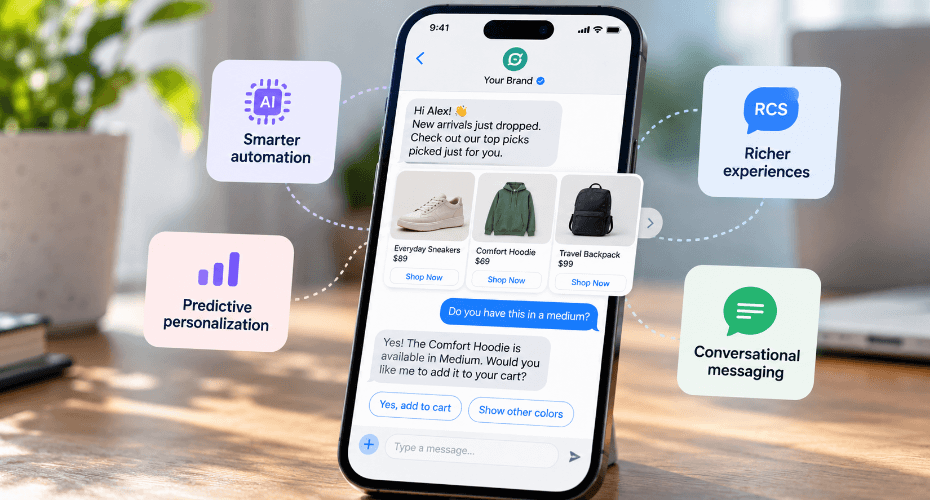
SMS marketing in 2027 will look increasingly different from the mass-text campaigns that defined the channel for years. Artificial intelligence, RCS, real-time customer data, predictive personalization, and conversational messaging are turning business texting into a more dynamic customer engagement channel.
However, traditional SMS is not disappearing. Instead, brands are building smarter messaging strategies around it. SMS provides dependable reach, while RCS adds richer experiences and AI helps determine who should receive a message, when it should arrive, and what it should say.
Current 2026 performance data already points toward this shift. Klaviyo reports that automated SMS flows represent only 7.6% of sends but generate 45.2% of SMS revenue across its benchmark data. Additionally, flow-based texts average nearly a 10% click rate, nearly double campaign performance.
Therefore, the biggest SMS marketing trends for 2027 will focus less on sending more messages and more on making every interaction relevant.
1. AI Will Move From Copywriting to Campaign Decisions
Generative AI initially entered SMS marketing as a copywriting assistant. Marketers could request five promotional messages, adjust the tone, and select their favorite.
In 2027, AI will increasingly influence decisions beyond message creation.
AI-powered marketing systems can evaluate browsing behavior, purchases, customer lifetime value, engagement, product availability, and previous conversations before selecting the next action.
For example, an AI system might determine that one subscriber should receive a replenishment reminder while another should receive nothing because they purchased recently.
Consequently, Marketers May Use AI To Control:
- Audience selection
- Product recommendations
- Send timing
- Message variations
- Channel selection
- Frequency
- Follow-up actions
- Customer-service routing
The biggest benefit may actually come from messages AI decides not to send. By suppressing irrelevant campaigns, brands can reduce fatigue while protecting engagement.
2. AI Agents Will Handle More SMS Conversations
AI agents represent the next stage of messaging automation. Unlike basic autoresponders, agents can interpret customer questions, retrieve information, take permitted actions, and decide what should happen next.
As a result, businesses will increasingly use them for product questions, appointment scheduling, lead qualification, order assistance, and simple support requests.
However, customers still expect quality. Twilio research found that 72% of consumers would choose an AI agent over a human if it guaranteed faster resolution. At the same time, only 39% currently describe AI agents as helpful, while 51% say the experiences feel robotic.
That gap will shape AI messaging in 2027.
Successful brands will not simply install chatbots. Instead, they will connect agents to accurate customer, order, product, and inventory data. They will also create clear paths to human support when AI cannot solve the problem.
3. RCS Will Become a Bigger Part of Mobile Marketing
RCS, or Rich Communication Services, will likely become one of the most important developments in mobile messaging heading into 2027.
Unlike standard SMS, RCS can support richer branded experiences, including high-quality media, suggested replies, buttons, cards, carousels, and interactive actions.
More importantly, its cross-platform position has improved substantially.
Apple added RCS support to iPhone beginning with iOS 18, and in May 2026, Apple and Google began rolling out end-to-end encrypted RCS conversations between supported iPhone and Android devices.
This broader ecosystem makes RCS increasingly attractive to marketers.
Twilio research also reports that 81% of surveyed global consumers prefer RCS over traditional SMS. Businesses already using RCS estimate average click rates of 37% and conversion rates of 21%, although marketers should treat vendor-reported performance figures as directional rather than universal benchmarks.
4. SMS and RCS Will Work Together
Despite the rise of RCS, brands should not expect SMS to vanish in 2027.
Instead, businesses will increasingly use a layered messaging model.
| Channel | Best Role |
|---|---|
| SMS | Universal alerts, reminders and simple promotions |
| MMS | Visual campaigns that need a single image or media asset |
| RCS | Branded, rich and interactive customer journeys |
| AI | Personalization, decisions and conversation automation |
For example, a retailer could send an interactive RCS product carousel when the recipient’s device supports it. However, customers without RCS support could receive a concise SMS with a link.
So SMS becomes a dependable fallback, while RCS creates a richer experience where available.
This hybrid approach gives brands innovation without sacrificing reach.
5. Personalization Will Become Predictive
Adding someone’s first name to a text no longer represents advanced personalization.
In 2027, SMS personalization will increasingly focus on predicting customer intent.
AI models can combine browsing patterns, purchase history, engagement, product preferences, loyalty status, and other first-party signals to estimate what a customer may need next.
For example, instead of sending every subscriber “20% off today,” a retailer could send:
- A replenishment reminder to a repeat buyer
- A back-in-stock alert to an interested shopper
- Early access to a high-value customer
- A product recommendation based on a recent purchase
- No promotional message to someone experiencing a support issue
Consequently, campaigns become more contextual.
However, personalization must remain useful, not intrusive. Customers want relevance, but many remain cautious about AI using extensive personal history. Twilio found that 66% of consumers feel uneasy about AI agents accessing their complete history with a business.
Therefore, transparent data practices will become part of good personalization.
6. Conversational Messaging Will Challenge the Traditional SMS Blast
One-way marketing blasts will continue, but two-way messaging will play a much larger role.
Consumers increasingly want to ask questions rather than simply click links. As a result, SMS, RCS, and other messaging channels can become miniature digital storefronts.
Twilio’s conversational messaging research found that 80% of surveyed consumers want brands to offer conversational messaging. Moreover, 77% want to use messaging when selecting a product or service, while 58% would consider purchasing directly through messaging when that option exists.
Therefore, a 2027 promotional message might not end with “Shop now.”
Instead, it could say, “Reply with what you’re looking for, and we’ll help you choose.”
The customer can then move from discovery to questions, recommendations, and purchase assistance without leaving the conversation.
7. Real-Time Customer Context Will Become Essential
AI cannot provide strong personalization when customer information sits inside disconnected systems.
Therefore, businesses will increasingly connect SMS platforms with ecommerce systems, CRMs, customer-service software, loyalty programs, and customer data platforms.
Real-time context matters because customer circumstances change quickly.
For Example, A Customer Might:
- Browse a product.
- Add it to the cart.
- Ask support a question.
- Purchase through another channel.
- Request a delivery update.
Without connected data, an automated system could still send an abandoned-cart promotion after the purchase.
Instead, 2027 messaging platforms will increasingly treat those events as one continuous customer journey. Twilio’s 2026 research similarly highlights fragmented customer data as a major barrier to contextual AI interactions.
8. Behavior-Triggered Messages Will Outperform Broad Campaigns
Behavioral messaging is already showing up in current performance data.
Klaviyo’s 2026 benchmarks show that SMS flows generate roughly eight times more revenue per recipient than campaigns on average. Moreover, 64.4% of flow revenue comes from new buyers, compared with 20% for campaigns.
Therefore, marketers should expect to invest more in automated messages triggered by specific customer actions.
High-value Examples Include:
- Welcome flows
- Browse abandonment
- Cart abandonment
- Back-in-stock alerts
- Price-drop notifications
- Replenishment reminders
- Post-purchase education
- Loyalty milestones
- Win-back campaigns
Instead of asking, “What promotion should we send today?” marketers will increasingly ask, “Which customers currently have a reason to hear from us?”
That distinction will define stronger SMS strategies.
9. Measurement Will Shift From Volume to Incremental Value
Traditional SMS reporting often emphasizes sends, clicks, and attributed revenue.
However, AI-powered personalization raises a more important question: Did the message drive an outcome that wouldn’t have happened otherwise?
Therefore, sophisticated marketers will increasingly use holdout groups, incrementality testing, revenue per recipient, conversion lift, unsubscribe rates, and customer lifetime value.
Frequency will also become an optimization metric.
For example, sending five campaigns might produce more attributed revenue than sending three. Nevertheless, those additional texts could increase opt-outs and reduce long-term customer value.
Consequently, the strongest SMS programs will optimize profitable customer relationships rather than maximizing message volume.

What Should Brands Prepare for in 2027?
Businesses do not need to replace their SMS programs to prepare for these trends. Instead, they should strengthen the foundations that enable smarter messaging.
Start with accurate first-party data, clear consent, reliable automation, behavioral triggers, and two-way messaging capabilities. Then, experiment with AI-driven segmentation, predictive personalization, conversational agents, and RCS where audience support makes sense.
Ultimately, the biggest SMS marketing trend of 2027 will not be AI or RCS alone.
It will be the transition from campaigns to conversations.
Brands that understand customer context, personalize responsibly, automate intelligently, and allow customers to respond will create messaging experiences that feel less like advertising and more like useful communication.