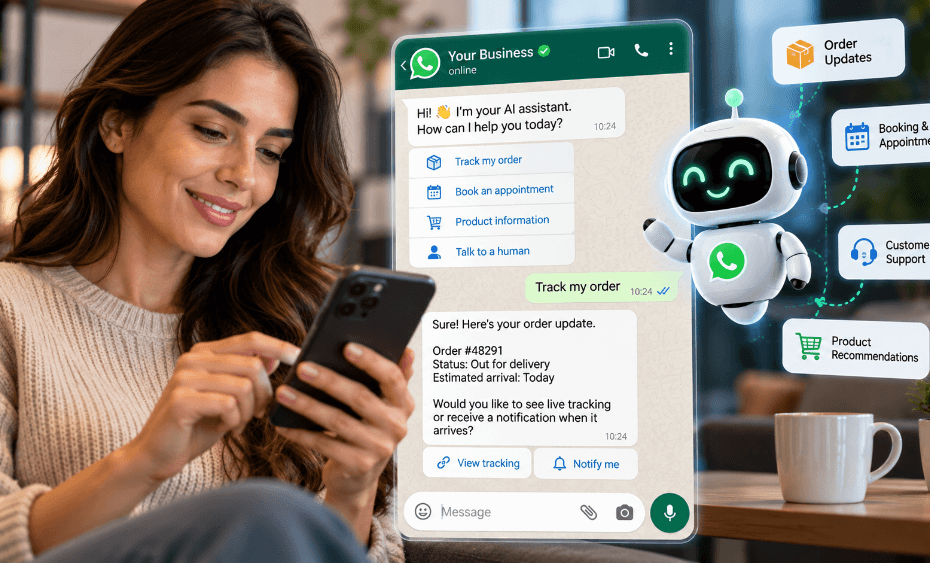
WhatsApp AI agents are changing customer service by bringing automation to one of the world’s most familiar messaging channels. Instead of forcing customers to call, email, or wait for a live chat window, businesses can now answer questions directly inside a WhatsApp conversation.
This matters because customers increasingly expect fast, simple, and personalized support. They want order updates, appointment details, product answers, pricing help, and troubleshooting without repeating themselves across channels. Therefore, WhatsApp AI agents give businesses a practical way to respond faster while keeping conversations conversational.
Additionally, Meta has made AI agents a bigger part of its business messaging strategy. In 2026, Meta introduced Meta Business Agent for WhatsApp and other messaging apps, positioning it as AI that helps businesses show up for customers even when teams are busy. As a result, automated WhatsApp conversations are moving from basic chatbots toward more capable AI-powered service experiences.
Quick Answer: What Is A WhatsApp AI Agent?
A WhatsApp AI agent is an automated conversational assistant that responds to customers through WhatsApp. It can answer common questions, collect customer details, recommend products, qualify leads, check order information, route issues, and hand conversations to a human agent when needed.
Unlike older rule-based bots, AI agents can understand more natural language. They can also follow business instructions, use brand voice, and, when connected to business systems, provide more personalized support. However, they still need clear guardrails, accurate data, escalation paths, and human oversight.
In simple terms, a WhatsApp AI agent helps businesses handle more conversations without making every customer wait for a person.
Why WhatsApp Is A Natural Channel For AI Support
WhatsApp works well for AI-powered customer service because it already feels personal, familiar, and immediate. Customers do not need to download a new app or open a support portal. Instead, they can message a business where they talk to friends, family, delivery services, and local shops.
This convenience changes customer behavior. A person may ignore a long email form, but they may quickly send a WhatsApp message asking, “Where is my order?” or “Do you have this size available?” As a result, WhatsApp can reduce friction at the start of the support journey.
Moreover, messaging is asynchronous. Customers can send a question, continue their day, and return when the answer arrives. This makes WhatsApp especially useful for retail, travel, healthcare scheduling, home services, real estate, education, finance, and local businesses.
How WhatsApp AI Agents Improve Customer Service
WhatsApp AI agents improve customer service by reducing response times and handling repetitive work. Many support teams spend large parts of the day answering the same questions: opening hours, prices, shipping status, return policies, appointment availability, and product details.
An AI agent can handle those questions instantly. Then, human agents can focus on complex, emotional, urgent, or high-value conversations.
Common benefits include:
- Faster first replies
- 24/7 support coverage
- Lower support workload
- More consistent answers
- Better lead qualification
- Personalized product recommendations
- Fewer missed messages
- Smoother handoff to human teams
However, the best results come when businesses treat AI as a support layer, not a full replacement for people.
Common WhatsApp AI Agent Use Cases
WhatsApp AI agents can support many customer-service workflows. For example, an ecommerce brand can use an agent to answer product questions, confirm delivery timelines, start returns, and recommend related items. A clinic can use one to answer scheduling questions and collect appointment preferences. A hotel can use one to answer questions about room availability, check-in details, and booking changes.
Here are practical examples:
| Use Case | What The AI Agent Can Do |
|---|---|
| Order Support | Share shipping updates, return steps, and delivery information |
| Appointment Booking | Collect preferred dates, times, and service needs |
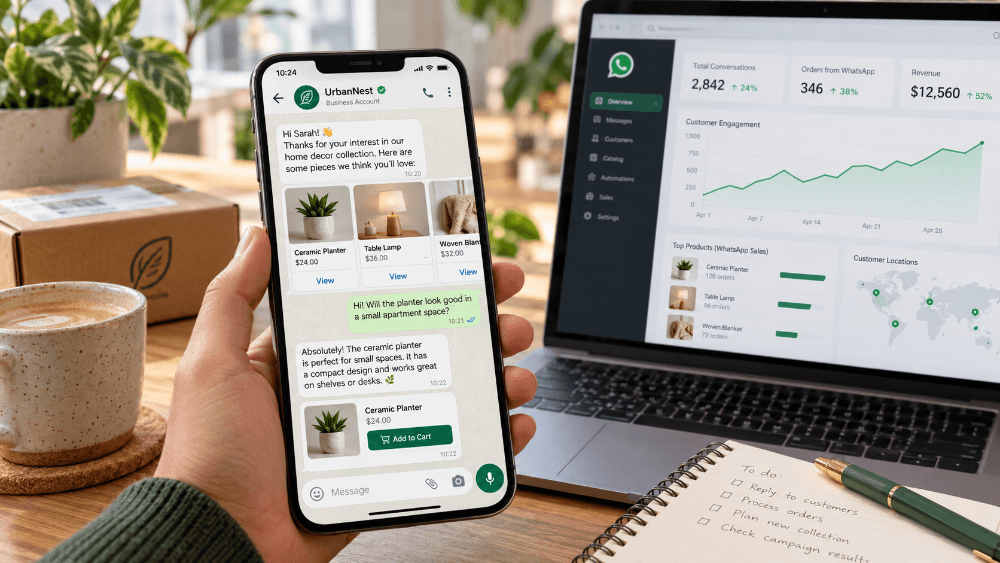
| Product Discovery | Recommend items based on customer preferences |
| Lead Qualification | Ask budget, timeline, location, and service questions |
| FAQ Support | Answer common policy, pricing, and availability questions |
| Issue Routing | Send complex cases to the right human team |
| Post-Purchase Help | Explain setup, usage, warranty, or next steps |
Because WhatsApp supports rich messaging formats, businesses can also use buttons, lists, images, documents, and links to make conversations easier to navigate.
From Chatbots To AI Agents
Older WhatsApp bots usually followed fixed flows. They worked well for simple menus, but they often failed when customers asked questions naturally. For example, a customer might type, “I ordered last Friday and still don’t have tracking,” while the bot only understood “track order.”
AI agents improve this experience by interpreting intent more flexibly. They can understand variations, ask follow-up questions, and respond in a more natural tone. They can also summarize conversation history so a human agent can take over faster.
However, AI agents still need structure. A business should define what the agent can and cannot answer, which tone it should use, and when it must escalate. Without those rules, AI can become inconsistent or overconfident.
Why Human Handoff Still Matters
Human handoff remains essential in WhatsApp AI customer service. Some conversations need empathy, judgment, negotiation, or account-specific decisions. For example, a billing dispute, complaint, medical concern, legal issue, or angry customer may require a trained person.
Therefore, the best WhatsApp AI agents should recognize limits. They should know when to connect the customer with a team member. They should also pass along context so the customer doesn’t have to repeat everything.
A good handoff includes:
- Customer name and contact details
- Conversation summary
- Customer intent
- Order or account information
- Urgency level
- Suggested next action
This keeps automation helpful, not frustrating.
Personalization And CRM Integration
The biggest value comes when WhatsApp AI agents connect with business systems. If the agent can access approved CRM, order, inventory, appointment, or product data, it can provide more useful answers.
For example, instead of saying, “Please check your tracking link,” the agent can say, “Your order is scheduled for delivery tomorrow.” Instead of saying, “Visit our website,” it can recommend products based on the customer’s size, location, or previous purchase.
However, personalization requires careful data handling. Businesses should collect only what they need, explain how they use customer information, and follow privacy and messaging rules. Additionally, sensitive industries should apply stricter controls before allowing AI to access customer records.
Risks And Challenges Of WhatsApp AI Agents
WhatsApp AI agents can improve service, but they also introduce risks. An AI agent may misunderstand a request, give outdated information, miss emotional cues, or answer beyond its allowed scope. If the business connects it to internal systems, the risk becomes even more serious.
Common challenges include:
- Incorrect or outdated answers
- Weak escalation paths
- Poor brand tone
- Lack of customer consent
- Privacy concerns
- Over-automation
- Missing CRM context
- Unclear ownership between AI and human teams
Therefore, businesses need testing, monitoring, analytics, and regular updates. AI support should improve over time, not operate untouched after launch.
Best Practices For WhatsApp AI Customer Service
Businesses should start with a focused use case rather than trying to automate everything. For example, begin with FAQs, lead qualification, appointment requests, or order-status questions. Then, expand after reviewing performance.
Strong best practices include:
- Train the agent on approved business information
- Use a clear brand voice
- Add strict escalation rules
- Keep answers short and helpful
- Review failed conversations weekly
- Connect systems only when needed
- Make human support easy to reach
- Track resolution rate and customer satisfaction
- Update knowledge when policies change
Additionally, businesses should avoid pretending the AI is human. Transparency builds trust, especially when customers need accurate support.
How AI Agents Change The Customer-Service Team
AI agents don’t eliminate the need for customer-service teams. Instead, they change what teams do. Automation handles repetitive questions, while humans manage complex cases, build relationships, drive retention, and provide high-value support.
This can improve employee experience. Agents spend less time repeating basic answers and more time solving meaningful issues. Moreover, managers can use AI conversation data to find customer pain points. If many people ask the same question, the website, product page, or checkout process may need improvement.
Therefore, when businesses use them strategically, WhatsApp AI agents can help both customers and internal teams.
Final Thoughts
WhatsApp AI agents are changing customer service by making automated conversations faster, more natural, and more useful. They help businesses answer common questions, qualify leads, recommend products, collect details, and support customers around the clock.
However, successful automation requires more than turning on AI. Businesses need accurate knowledge, clear guardrails, privacy controls, CRM integration, and human handoff. Ultimately, the goal is not to replace customer service with automation. The goal is to make every conversation faster, clearer, and easier for both the customer and the support team.