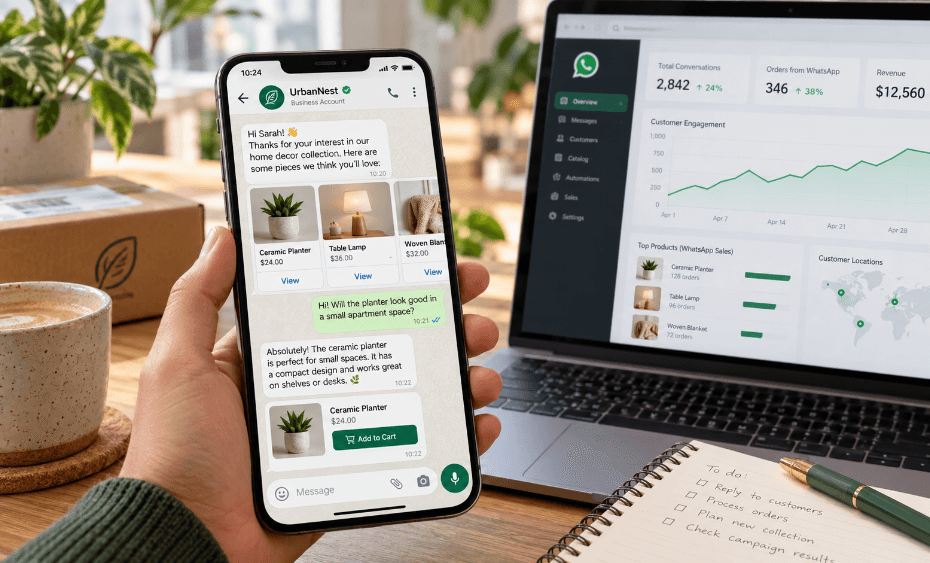
WhatsApp has evolved far beyond personal conversations. Today, businesses use the platform to attract leads, recommend products, answer questions, recover lost sales, send updates, and maintain post-purchase relationships.
More importantly, WhatsApp combines marketing and customer service inside the same conversation. A customer might discover a product through an advertisement, ask a question in WhatsApp, receive a recommendation, complete a purchase, and later return to the same chat for support.
That conversational model creates opportunities that traditional one-way marketing channels cannot easily replicate. However, successful WhatsApp Business marketing requires more than sending promotional messages. Brands need permission, relevant content, useful automation, and a clear reason for customers to keep the conversation going.
What Is WhatsApp Business Marketing?
WhatsApp Business marketing means using WhatsApp’s business tools to attract, engage, convert, and retain customers through messaging.
Small companies can use the WhatsApp Business app for everyday conversations. Meanwhile, larger businesses and brands that need automation, integrations, and higher messaging volumes can use the WhatsApp Business Platform.
Consequently, companies can use WhatsApp across several stages of the customer journey:
- Lead generation
- Product discovery
- Promotional campaigns
- Customer support
- Appointment scheduling
- Order updates
- Personalized recommendations
- Customer retention
- Re-engagement campaigns
WhatsApp’s scale makes these use cases particularly significant. In 2025, Meta reported that more than two billion people use WhatsApp daily and that millions already communicate with businesses on the platform.
How WhatsApp Turns Marketing Into Conversations
Traditional digital marketing often follows a predictable path. A customer sees an ad, clicks a link, lands on a website, searches for information, and eventually finds a checkout or contact form.
WhatsApp can shorten that journey considerably.
Click-to-WhatsApp Advertising
Brands can run advertisements on Facebook and Instagram that open a WhatsApp conversation when someone clicks.
For example, a furniture retailer might advertise a new sofa collection with a call to action such as “Message us for available colors.”
Instead of navigating multiple product pages, the customer can immediately ask:
“Is this available in dark gray, and how long does delivery take?”
The business can answer the question, recommend alternatives, and move the shopper toward a purchase.
Moreover, Meta reported that click-to-message advertising continued to gain momentum during 2025. In Q4, U.S. click-to-message ad revenue grew more than 50% year over year.
As a result, messaging increasingly functions as both an advertising destination and a conversion channel.
Ads in WhatsApp Status
WhatsApp is also becoming a discovery environment, not just a private inbox.
Meta introduced advertising in the Status area of WhatsApp’s Updates tab, alongside promoted Channels and Channel subscriptions. Importantly, these advertising experiences remain separate from personal chats.
As a result, a customer may discover a business in WhatsApp and start a conversation directly from the ad.
This creates a shorter path between discovery and engagement.
How Brands Use WhatsApp to Drive Sales
WhatsApp works especially well when customers need information before deciding.
Instead of sending everyone directly to checkout, businesses can use messaging to resolve uncertainty.
Product Recommendations
A customer might say:
“I need a lightweight jacket for rainy weather.”
The business can ask follow-up questions, identify appropriate products, and send relevant recommendations.
As a result, the customer receives guidance rather than a generic promotional link.
AI is making this process more scalable. In June 2026, Meta expanded its Business Agent capabilities, allowing businesses to use AI to answer questions, recommend products from catalogs, qualify leads, book appointments, and help close sales. Meta also reported that more than one million businesses were already using a Meta Business Agent across WhatsApp and Messenger.
Personalized Promotions
WhatsApp can also support targeted offers based on customer interests or previous interactions.
For example, businesses might send:
- Back-in-stock notifications
- Product launches
- Loyalty rewards
- Seasonal promotions
- Replenishment reminders
- Limited-time discounts
- Event invitations
However, relevance matters.
WhatsApp limits marketing messages and gives users tools to indicate whether offers interest them. Customers can also block or report businesses and adjust their messaging preferences.
As a result, brands should prioritize useful messages over maximizing campaign frequency.
WhatsApp Supports Conversational Commerce
Conversational commerce combines messaging with the buying journey.
Instead of treating chat as a support channel that begins after a purchase, brands use the conversation itself to influence the purchase.
A Typical WhatsApp Journey Might Look Like This:
- Customer sees a Facebook or Instagram ad.
- Customer starts a WhatsApp conversation.
- Business identifies what the customer needs.
- AI or a human recommends suitable products.
- Customer asks questions.
- Business shares purchasing information or a checkout path.
- Customer receives order updates in the same conversation.
- Business provides post-purchase support later.
Therefore, a single messaging thread can connect acquisition, conversion, and retention.
Recent Meta research in India illustrates that potential. In 2026, Meta reported that retailers using Business Messaging and Click-to-WhatsApp campaigns saw an average 61% improvement in return on ad spend, a 62% increase in leads, and 22% higher order values. Results will naturally vary by business and market, but the findings show conversational commerce’s potential.
AI Is Expanding WhatsApp Marketing Automation
Automation used to mean fixed replies and simple chatbots. However, AI agents can now interpret broader customer requests and decide what information to share or what action to take next.
For instance, an AI agent might handle:
| Customer Request | Possible AI Action |
|---|---|
| “Is this available?” | Check product availability |
| “Which one should I buy?” | Recommend products |
| “Can I book tomorrow?” | Check appointment slots |
| “Where is my order?” | Retrieve order status |
| “I need a quote.” | Ask qualifying questions |
| “I want a person.” | Transfer to a human agent |
Meta’s Business Agent Platform can also connect to external systems such as Shopify and Zendesk, letting businesses build richer workflows around customer data and operations.
Nevertheless, businesses should maintain boundaries. AI should not invent product availability, discounts, delivery dates, or policies. Instead, it should retrieve that information from verified systems.
Centralized Campaign Management Is Growing
WhatsApp marketing is also becoming more closely connected with the wider Meta advertising ecosystem.
Meta introduced centralized campaign management that allows businesses to coordinate marketing across WhatsApp, Facebook, and Instagram through Ads Manager. Businesses can upload subscriber audiences and add WhatsApp marketing messages as a placement, while Meta’s Advantage+ systems can optimize budgets across supported placements.
As a result, brands can increasingly treat WhatsApp as part of an omnichannel strategy rather than an isolated messaging tool.
For example, one campaign could use Instagram to generate awareness, WhatsApp to answer buying questions, and customer data to support follow-up communication.
Customer Service Strengthens Marketing Results
Sales and customer service become closely connected inside messaging channels.
A customer considering a purchase may ask about sizing, delivery, compatibility, returns, or payment options. Therefore, a fast support response can directly influence conversion.
After the purchase, WhatsApp can also handle:
- Shipping updates
- Order questions
- Returns
- Appointment changes
- Warranty information
- Product guidance
- Feedback requests
Moreover, larger businesses can increasingly offer calls alongside messaging. Meta has expanded calling options for businesses using the WhatsApp Business Platform, giving customers another way to handle conversations that become too complicated for text alone.
As a result, messaging can become an ongoing customer relationship rather than a collection of isolated campaigns.
Consent and Message Quality Matter
WhatsApp marketing differs from channels where businesses can simply acquire a list and begin broadcasting messages.
Users need control over business communication.
Businesses should therefore collect appropriate opt-ins and clearly explain the type of messages customers can expect. Brands should also avoid adding people to promotional messaging simply because they previously contacted customer support.
WhatsApp also requires businesses using its Business Platform to use approved templates when initiating certain conversations. Additionally, Meta monitors message quality and can restrict businesses that repeatedly violate its policies.
Therefore, marketers should view customer permission as an ongoing relationship rather than a one-time checkbox.
How to Measure WhatsApp Marketing Performance
Message delivery alone does not show whether WhatsApp contributes to business growth.
Instead, marketers should connect messaging activity with customer outcomes.
Useful metrics include:
- Conversation-start rate
- Response rate
- Read rate
- Qualified leads
- Conversion rate
- Revenue per conversation
- Cost per lead
- Average order value
- Support resolution rate
- Human escalation rate
- Opt-out or block rate
Brands should also compare automated conversations with human-assisted journeys.
For example, AI may resolve routine questions extremely efficiently, while human agents may perform better for complicated or high-value purchases.
Is WhatsApp Business Marketing Worth Using?
For businesses whose customers already use WhatsApp, the platform can become much more than another promotional channel.
It can connect advertising, product discovery, customer questions, recommendations, purchases, order communication, and support inside a continuous conversation.
However, success depends on how brands use that access.
Businesses that send constant generic promotions may quickly create fatigue. Conversely, brands that respond to customer intent, personalize responsibly, automate routine interactions, and provide human help when needed can make WhatsApp genuinely useful.
Ultimately, WhatsApp Business marketing works best when brands stop thinking like broadcasters and start thinking like conversational businesses.
The opportunity isn’t simply to place ads in another channel. Instead, it is about turning customer interest into a conversation—and that conversation into a stronger customer relationship.